
A complete, stage-by-stage guide to revenue cycle management for mental health and substance use treatment practices.
Behavioral health practices live and die by their revenue cycle. You can deliver outstanding clinical care, fill every slot on the calendar, and still run dangerously low on cash if claims are denied, authorizations lapse, or documentation falls short of payer expectations. Behavioral health revenue cycle management (RCM) is the discipline that prevents that outcome — the end-to-end financial process that turns a covered therapy session, psychiatric evaluation, or substance use treatment into accurate, timely reimbursement.
Unlike general medical billing, behavioral health RCM has to absorb a unique set of pressures: multiple session types billed per patient, time-based psychotherapy codes where a single minute changes the claim, prior authorization on nearly every service, mental health parity rules, and overlapping privacy regulations like HIPAA and 42 CFR Part 2. Because this site focuses exclusively on behavioral health RCM, this guide walks through exactly how the process works, where it breaks down, and what a well-run cycle looks like.
Behavioral Health RCM, Defined
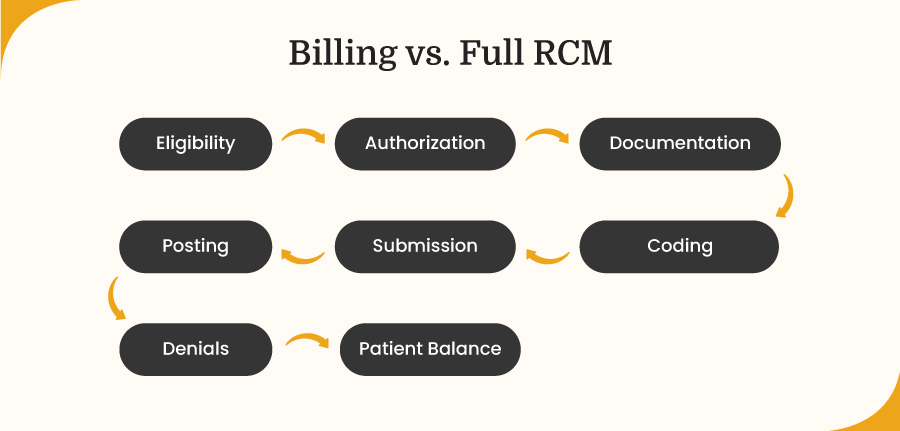
Revenue cycle management is the coordinated financial process used to track a patient’s account from the very first inquiry through the final dollar collected. It is broader than billing. Billing is the narrow act of preparing and submitting claims. RCM covers everything before and after submission that determines whether those claims actually get paid — eligibility, authorization, documentation, coding, posting, denials, appeals, and patient balances.
In behavioral health specifically, that cycle demands far more precision than a typical primary-care office. A single patient may receive individual therapy, group therapy, and medication management in the same week, each with its own code, modifier, and payer rule. Reimbursement increasingly hinges on demonstrating medical necessity and clinical outcomes, not just on the volume of visits delivered. When all the moving parts work as one system, the practice sees steadier cash flow and clinicians spend less time fighting paperwork.
The Behavioral Health RCM Process, Stage by Stage
Although every organization labels things slightly differently, a healthy behavioral health revenue cycle moves through eight connected stages. A failure at any one stage cascades downstream, so each step is treated as a control point rather than a handoff.
1. Patient Intake, Scheduling & Registration
The cycle begins before the clinical encounter. Accurate demographic capture, correct payer identification, and clean subscriber details at registration prevent the small data errors that later surface as rejections. In behavioral health, intake also flags whether a service line — such as substance use treatment — carries additional consent or confidentiality requirements under 42 CFR Part 2.
2. Insurance Verification & Eligibility
Eligibility verification confirms active coverage, behavioral health benefits, session limits, copays, deductibles, and any carve-out to a managed behavioral health organization. Behavioral health benefits are frequently administered separately from medical benefits, so a patient who is covered for a primary-care visit may have entirely different limits — or a separate payer — for therapy. Automated, real-time eligibility checks catch these gaps before the first session rather than after a denial.
3. Prior Authorization
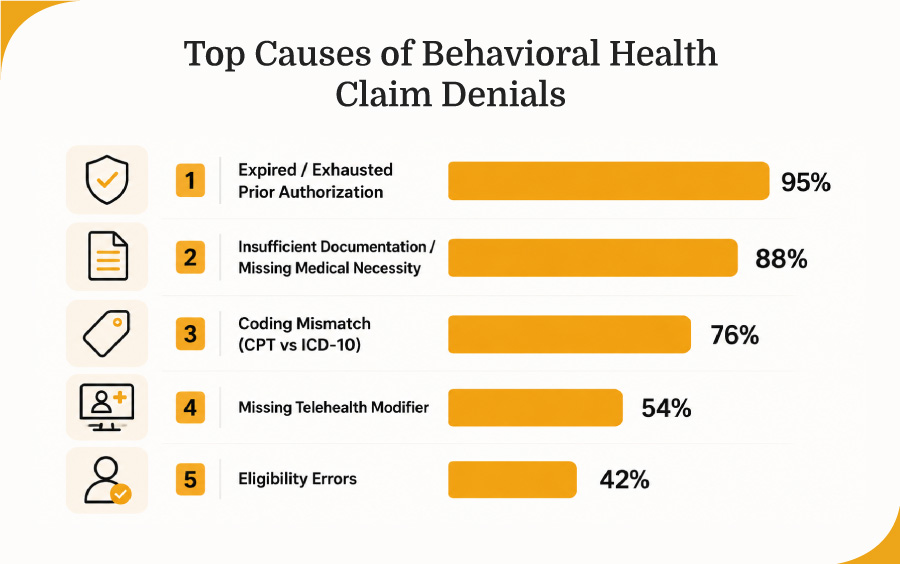
Few specialties rely on prior authorization as heavily as behavioral health. Many payers require pre-authorization for psychotherapy beyond an initial number of sessions, for intensive outpatient programs, and for most substance use treatment. Tracking authorization numbers, covered units, and expiration dates is a full-time responsibility; a lapsed or exhausted authorization is one of the most common — and most preventable — reasons a behavioral health claim is denied.
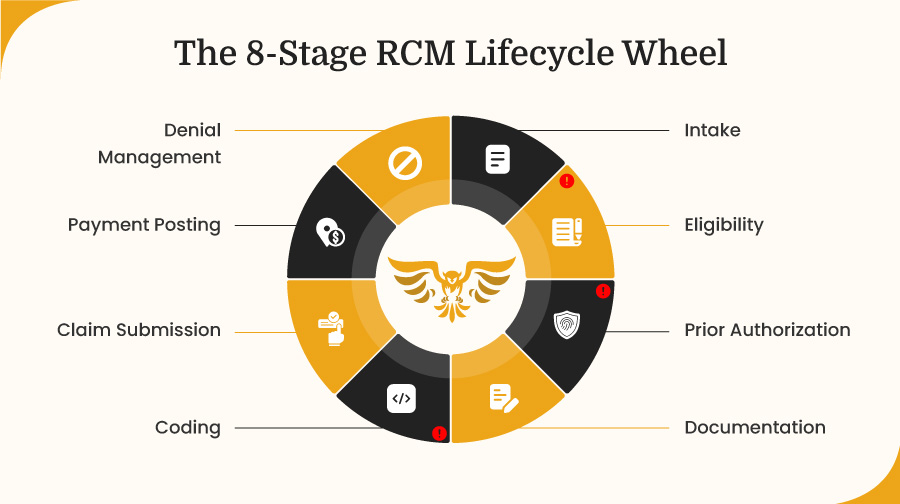
4. Clinical Documentation
Documentation is where clinical and financial integrity meet. Payers expect notes that justify medical necessity: presenting problem, diagnosis, interventions used, patient response, risk assessment, and — critically for time-based codes — documented start and stop times. Strong documentation is also the practice’s primary defense in a payer audit. Weak or templated notes are the root cause behind a large share of behavioral health denials.
5. Medical Coding
Coding translates the documented encounter into the standardized language payers understand. Behavioral health billing runs on three coding systems working together: CPT codes describe the service delivered, ICD-10-CM codes establish the diagnosis and medical necessity, and HCPCS Level II codes (such as H-codes) cover supplemental services often used in Medicaid. When the procedure and diagnosis don’t align, the entire claim is rejected.
The most frequently billed behavioral health CPT codes include:
| CPT Code | Service Description |
|---|---|
| 90791 | Psychiatric diagnostic evaluation (without medical services) — used for intake assessments by non-prescribing providers |
| 90792 | Psychiatric diagnostic evaluation with medical services — used by psychiatrists and PMHNPs when prescribing is involved |
| 90832 | Individual psychotherapy, 30 minutes (16–37 minute sessions) |
| 90834 | Individual psychotherapy, 45 minutes (38–52 minute sessions) |
| 90837 | Individual psychotherapy, 60 minutes (53+ minute sessions) |
| 90846 / 90847 | Family psychotherapy without (90846) and with (90847) the patient present |
| 90853 | Group psychotherapy |
| 90839 / 90840 | Crisis psychotherapy — first 60 minutes (90839) and each additional 30 minutes (90840) |
| +90785 | Interactive complexity add-on (e.g., interpreter use, acute safety planning) |
Telehealth sessions generally use the same CPT codes with modifier 95 and the appropriate place-of-service code (02 or 10). Because time thresholds are exact, billing 90837 for a 50-minute session is treated as upcoding and invites audits — a reminder that coding accuracy is itself a compliance issue.
6. Claim Submission
Coded claims are scrubbed for errors and submitted electronically through a clearinghouse on the CMS-1500 form. Automated claim scrubbing checks for missing modifiers, mismatched diagnosis-to-procedure pairings, exhausted authorizations, and NCCI edit conflicts before the claim ever reaches the payer. The goal at this stage is a high first-pass acceptance rate, because every claim caught internally is one that doesn’t have to be reworked weeks later.
7. Payment Posting & Reconciliation
When remittances arrive, payments are posted from the electronic remittance advice (ERA) and reconciled against the explanation of benefits (EOB). Posting isn’t clerical busywork — it’s where underpayments, incorrect adjustments, and partial denials are detected. Accurate posting reveals whether the payer actually honored the contracted rate.
8. Denial Management, Appeals & Patient Collections
No cycle is denial-free. Mature behavioral health RCM treats every denial as data: each is sorted by its CARC/RARC reason code, the root cause is corrected, and a payer-specific appeal is filed within the deadline. The same rigor extends to patient balances. With high-deductible health plans now common, patients owe a larger share than ever, so transparent statements and clear payment options are essential to actually collecting earned revenue.
Why Behavioral Health RCM Is Harder Than General Medical Billing
Behavioral health practices typically operate on thin margins and high patient volumes, which leaves little room for revenue leakage. Several factors make the cycle uniquely difficult:
- Multiple services per patient. Therapy, medication management, and group sessions stack up in a single week, each with distinct codes and rules.
- Time-based coding precision. The line between 90834 and 90837 is a matter of minutes, and getting it wrong means either lost revenue or audit exposure.
- Heavy prior-authorization burden. More services require pre-approval than in most specialties, creating constant administrative bottlenecks.
- Layered compliance. Practices must satisfy HIPAA, 42 CFR Part 2, the Mental Health Parity and Addiction Equity Act, and state-specific behavioral health laws simultaneously.
- Variable payer rules. A service Medicare pays cleanly may be denied by a commercial payer like UnitedHealthcare, Aetna, or Cigna under different documentation requirements.
Industry research underscores the stakes: practices with inefficient billing processes can lose a significant share of earned revenue, while organizations that implement structured RCM frequently reduce denial rates and shorten reimbursement timelines measurably.
The Metrics That Reveal a Healthy Cycle
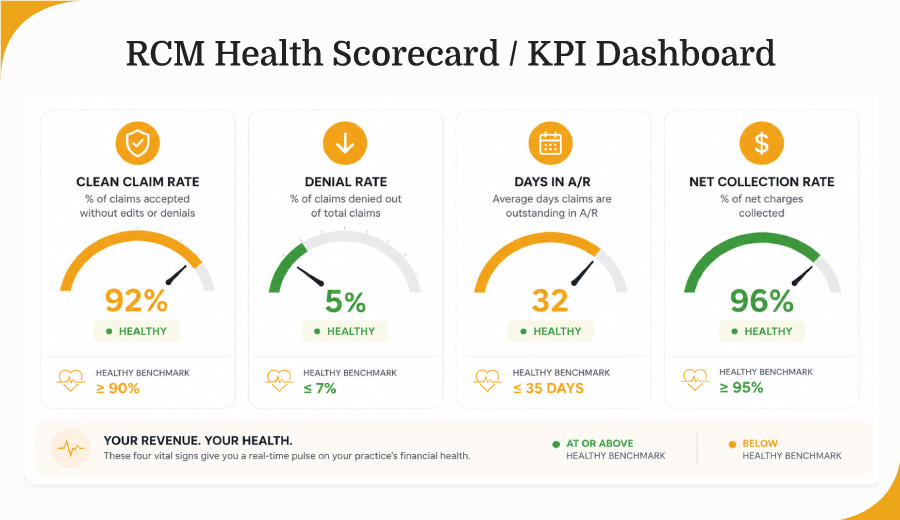
You cannot improve what you don’t measure. A few core key performance indicators (KPIs) tell you whether a behavioral health revenue cycle is working:
- Clean claim / first-pass rate — the percentage of claims paid on first submission without rework.
- Denial rate — the share of claims rejected; a rising rate points to upstream eligibility, authorization, or coding problems.
- Days in accounts receivable (A/R) — how long, on average, it takes to get paid after the service.
- Net collection rate — how much of the contractually owed revenue is actually collected.
Tracked together, these metrics turn the revenue cycle from a monthly guessing game into a forecastable system — and they expose exactly which stage to fix first.
In-House vs. Specialized Behavioral Health RCM
Many practices begin by managing the revenue cycle in-house, then discover that the combination of authorization tracking, time-based coding, denial appeals, and shifting payer rules consumes more administrative capacity than clinical staff can sustain. That is why a growing number of behavioral health organizations partner with specialists who do nothing but this work. A dedicated behavioral health RCM partner brings payer-specific expertise, proactive denial prevention, audit-ready documentation support, and transparent reporting on claim status, root causes, and next actions.
The right partner doesn’t just submit claims faster — it closes the gaps where revenue quietly leaks: eligibility blind spots, expired authorizations, undercoded sessions, and unworked denials. The result is a more predictable cash flow that lets clinicians focus on patients instead of paperwork.
The Bottom Line
The behavioral health RCM process is far more than billing. It is an interconnected system that begins the moment a patient schedules an appointment and ends only when every earned dollar — from payers and patients alike — is collected. Each stage, from eligibility and prior authorization through documentation, coding, submission, posting, and denial management, is a control point where revenue is either protected or lost. Get the cycle right, and financial stability follows; get it wrong, and even a thriving clinical practice can struggle to stay solvent.