
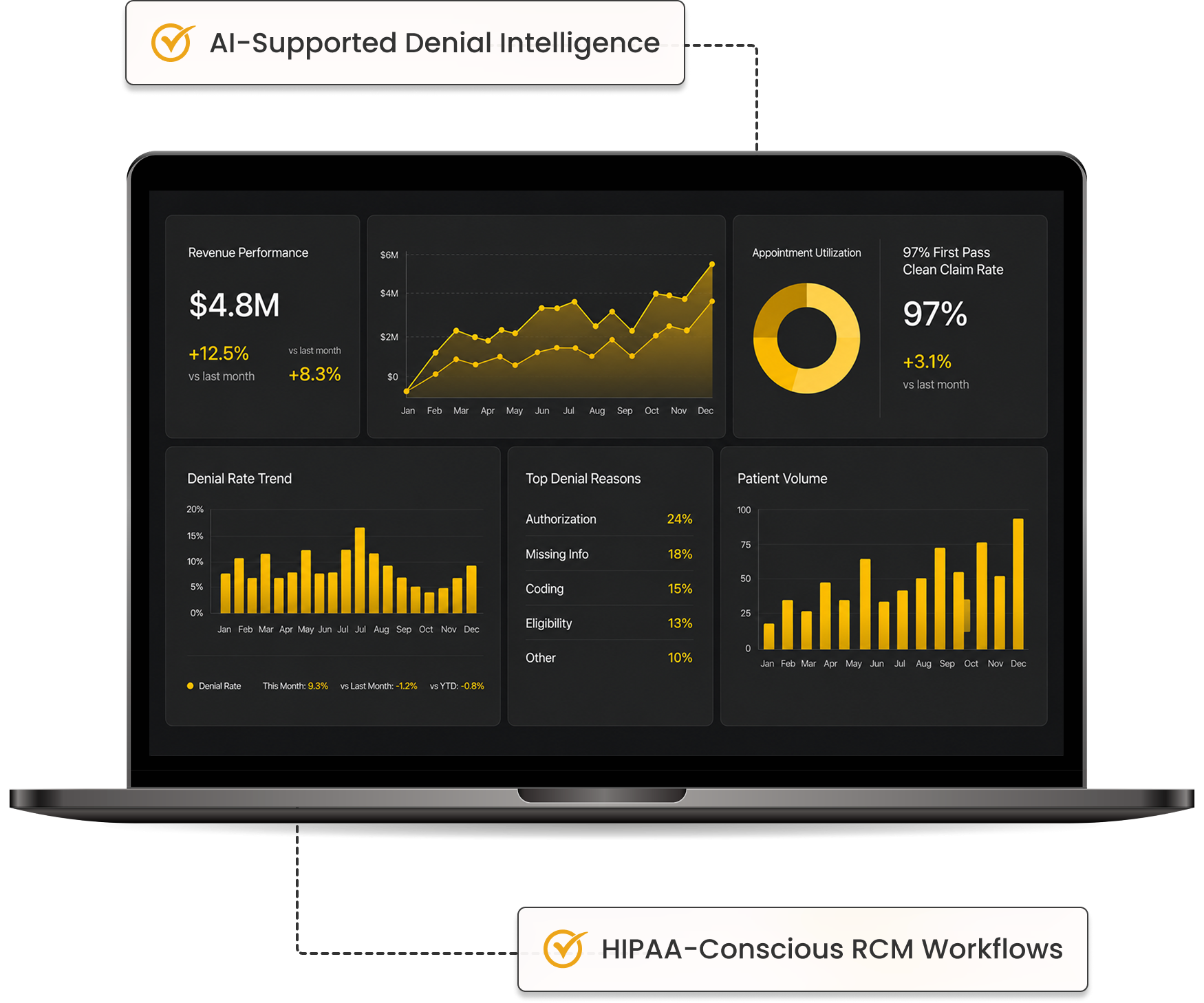
Generic billing workflows often miss the payer rules, claim gaps, authorization issues, and denial patterns that delay reimbursement. The Hamill Group helps healthcare organizations strengthen clean claim performance, denial management, A/R visibility, and specialty-specific revenue cycle workflows
Get a Plan Now



RCM Services Healthcare That Keep Claims Clean, Compliant, and Collectible
We code with payer rules, specialty notes, modifiers, bundling edits, and medical necessity in mind. Each claim is reviewed to reduce rework, prevent avoidable denials, and support cleaner reimbursement from the first submission.
We manage provider enrollment, payer applications, CAQH updates, revalidations, and follow-ups before they slow revenue down. Our process helps providers stay active, billable, and ready to see patients without payment delays.
We find the denial reason, correct the claim issue, and track patterns across payers, codes, and workflows. This helps reduce repeat denials, recover unpaid revenue, and stop the same errors from draining collections again.
We review claims, coding, documentation, modifiers, payment trends, and payer behavior to catch hidden revenue risk. Our audits help uncover underpayments, compliance gaps, billing errors, and process issues before they become costly.
We handle behavioral health billing with attention to authorizations, session rules, documentation needs, payer limits, and recurring claim patterns. This helps reduce delays and protect revenue for therapy, psychiatry, and mental health services.
We help healthcare organizations protect revenue where it is most often lost: complex payer logic, claim behavior, reimbursement gaps, and operational blind spots.
We help claims move with fewer payment delays.
We target revenue leakage hidden in billing workflows.
Our team understands modifiers, payer edits, and reimbursement rules.
We identify repeat issues before they become revenue loss.


We study your billing flow, payer mix, claim issues, and collection gaps.

We tighten claim accuracy before errors move into the payer system.

We monitor payer behavior, delays, underpayments, and denial trends.

Our AI helps find root causes so the same revenue leaks do not repeat.

We push aging claims forward before they become lost revenue.
Most practices do not lose revenue in one obvious place. It slips through gaps no one is tracking closely enough. We bring those weak points into view before they become permanent losses.


Each practice came to The Hamill Group with a different revenue issue. Our team used focused RCM analysis, payer logic, and workflow correction to move claims forward.

“They were in our EMR within 24 hours, fixed our billing crisis, and claims started paying. Attentive, fast, and highly recommended.”

MD @ The Franz Center
“Every clinician I’ve referred to THG has reported a great experience. Knowledgeable, responsive, and invested in quality services.”

JD @ Clinical Best Practice Institute LLC
“One of the most talented revenue cycle leaders in healthcare. I highly recommend The Hamill Group.”

@ Denova Collaborative Health

@ Touchstone Health Services
The Eye Specialists of Napa Valley
Interim, CEO, CFO
Rated 4.5/5


“We had too many therapy claims sitting unpaid because payer rules kept changing. The Hamill Group reviewed our denial codes, mapped authorization gaps, and rebuilt our follow-up workflow.”
BrightPath Behavioral Care
“Our surgical claims were getting underpaid, but our team could not find the pattern. The Hamill Group checked modifiers, fee schedules, and payer edits. They found the gap, corrected the claim logic.”
Westbridge Surgical Group
“Credentialing delays were stopping new providers from billing on time. The Hamill Group organized payer files, tracked enrollment status, and cleared missing documentation.”
We do not treat billing as a back-office task. We study the payer behavior, claim friction, denial patterns, and reimbursement gaps that decide how much revenue actually reaches your practice.

We work on the hard parts of your RCM. Every number is reviewed for what it means, what it costs, and what action should happen next.
We understand how specialty rules, modifiers, payer edits, and documentation gaps affect payment outcomes.
We use data insights to flag denial risks, claim delays, and payer issues before they grow.
We track payer behavior, underpayment patterns, and rule changes that impact collections.
We give practices clearer visibility into what is paid, delayed, denied, and recoverable.
Compliance failures do not always look serious at first. They often start with a modifier error, weak documentation, payer-rule mismatch, or missed audit trail. The Hamill Group helps practices keep revenue moving while staying aligned with billing, coding, payer, and regulatory expectations.Medical practices and behavioral health organizations work with The Hamill Group because they need revenue cycle control, not just claim submission. Our team helps improve billing visibility, payer follow-up, denial accountability, and AR workflow support through hands-on account management and technical RCM expertise.
We keep claim actions, payer responses, and follow-up notes organized so practices can answer audits with confidence.
Every claim touchpoint is checked against payer logic, documentation needs, and billing compliance standards.
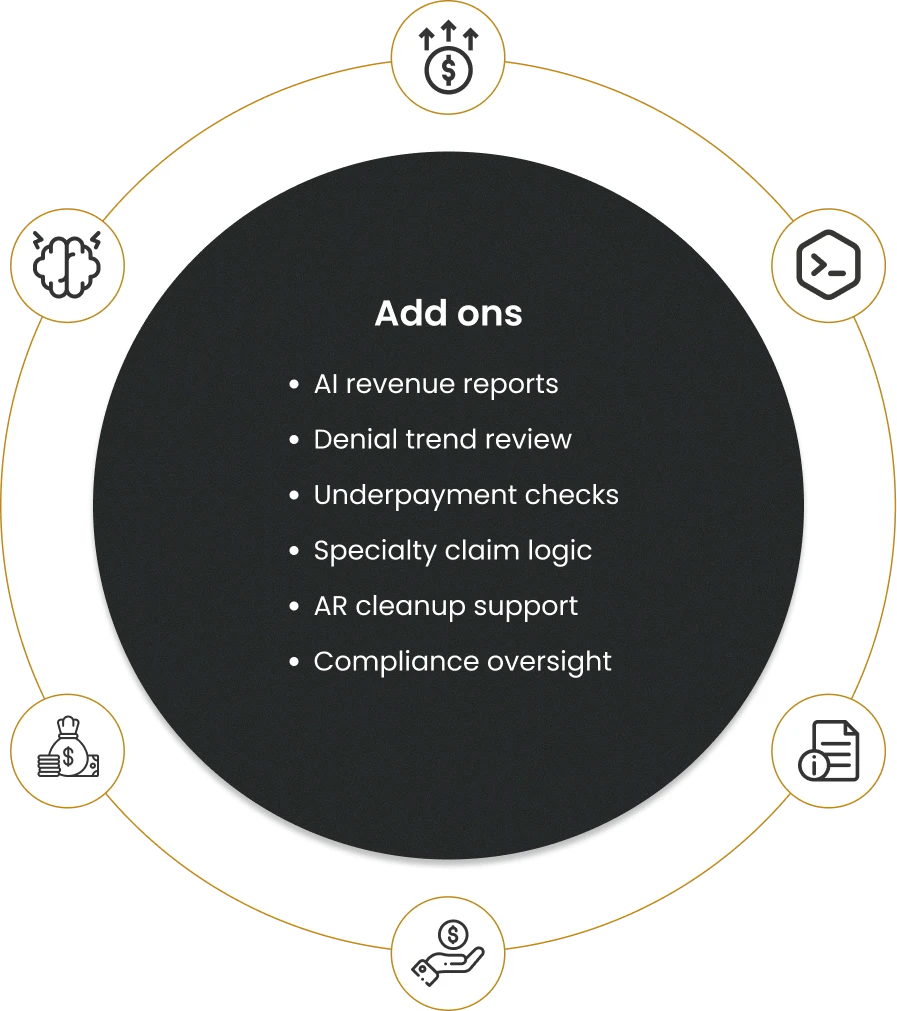
The Hamill Group supports providers across the U.S. with RCM knowledge built around state-level payer behavior, Medicaid differences, commercial plan rules, claim edits, authorization patterns, and reimbursement risk. We help practices manage revenue with cleaner data, sharper follow-up, and stronger control across every market.
Our system fits into your current workflow without forcing a platform change. We work across leading EHR, PM, clearinghouse, and billing systems to manage claims, payments, denials, AR, eligibility data, and reporting with cleaner handoffs and fewer workflow breaks.








We manage payer variation, rule changes, claim edits, and reimbursement gaps across commercial, Medicare, Medicaid, and specialty payer networks.
We manage Medicaid billing with attention to state rules, payer edits, authorization limits, enrollment status, and documentation gaps that often delay reimbursement.
We handle Medicare claims with a focus on medical necessity, modifiers, LCD/NCD logic, coding accuracy, and audit-ready documentation.
Complex Case Payment Support
We manage workers’ comp claims through injury details, employer data, authorization tracking, payer rules, and follow-up needed for slow-moving payments.
Our medical billing services cover eligibility checks, VOB, charge review, CPT/ICD-10/HCPCS validation, 837 claim submission, clearinghouse rejection correction, 835 ERA posting, denial management, AR follow-up, secondary billing, and KPI reporting.
Most billing companies submit claims and follow up after problems happen. THG manages the revenue cycle workflow behind the claim, including front-end controls, payer-specific edits, denial root-cause analysis, AR segmentation, and executive reporting.
Yes. THG can support professional and institutional billing workflows where applicable, including 837P/837I claim submission, payer edits, payment posting, denial routing, and AR follow-up.
We review claims before submission for NPI, taxonomy, POS, modifiers, diagnosis pointers, subscriber details, COB sequencing, authorization linkage, payer edits, and documentation gaps.
Yes. THG can work with internal billing teams, Physicians, Coders, front-desk staff, Accounts Managers, administrators, and leadership to improve claim ownership, payer follow-up, and revenue visibility.
THG supports billing for therapy, psychiatry, counseling, group therapy, SUD, IOP, PHP, telehealth visits, and multi-provider behavioral health organizations.
We track authorization numbers, approved units, CPT/HCPCS codes, provider details, date ranges, payer rules, documentation requests, re-authorization deadlines, and concurrent review needs.
Yes. THG reviews telehealth claims for POS 02/10, modifiers 95, GT, or GQ where applicable, payer-specific rules, documentation support, authorization status, and session-level coding accuracy.
We classify denials by CARC/RARC, payer, CPT, provider, authorization status, service line, documentation issue, and workflow source to identify whether the root cause is VOB, authorization, coding, documentation, or payer policy.
Pricing depends on specialty, claim volume, payer mix, provider count, number of locations, EHR/PM setup, denial volume, AR cleanup needs, credentialing scope, reporting requirements, and service complexity.
It may, because behavioral health often requires deeper VOB, recurring authorization tracking, telehealth validation, H-code support, session-level review, and payer-specific documentation management.
Aged AR cleanup is usually reviewed separately because old claims require denial analysis, timely filing checks, payer status review, appeal validation, underpayment review, and recoverability scoring.
Pricing can be structured based on the client’s scope, volume, specialty, and revenue cycle needs. Final pricing is confirmed after reviewing claim volume, payer mix, AR status, EHR setup, and workflow complexity.
Review your claim volume, denial rate, AR over 90 days, payer mix, provider count, authorization volume, EHR limitations, credentialing gaps, and reporting needs. These factors affect the scope and pricing model.
No. THG works with your existing EHR and helps optimize your current workflows, integrations, and revenue cycle processes.
THG reviews key workflows including patient registration, eligibility, charge capture, coding, claim submission, payment posting, denials, and reporting.
THG reviews claim transmission, rejection reports, payer responses, and clearinghouse data to identify integration or workflow issues affecting claims.
Yes. THG can help identify issues with 835 ERA files, payment posting, remittance mapping, and reconciliation workflows.
Yes. THG can review documentation and transcription handoffs to identify workflow gaps that may contribute to coding, billing, or claim delays.
THG follows compliance-focused workflows that support role-based access, secure documentation, PHI handling controls, payer record management, BAA requirements where applicable, and audit-ready billing notes.
Yes. THG works around HIPAA-related billing workflows, including 837 claim submission, 835 ERA posting, 270/271 eligibility, 276/277 claim status, and 278 authorization/referral workflows where applicable.
THG can help organize claim notes, payer communication, appeal documentation, authorization records, EOB/ERA files, denial history, and supporting documentation needed for payer audit response.
We review coding alignment, documentation support, payer requirements, authorization status, provider setup, billing notes, payment adjustments, and repeat denial patterns to reduce preventable exposure.
Let’s Start Saving with Our Expert Healthcare RCM Services