
How the psychiatric diagnostic evaluation code works, what it pays in 2026, and why it’s one of the most frequently denied codes in mental health billing.
For nearly every behavioral health practice, the revenue story of a new patient begins with a single code: CPT 90791. It’s the gateway to the entire episode of care — the first comprehensive intake session that establishes the diagnosis, the treatment plan, and the clinical justification for everything that follows. It’s also one of the most commonly billed codes in mental health, and, unfortunately, one of the most frequently denied.
When a 90791 claim is denied or underpaid, the damage rarely stops at one line item. Because this code anchors the start of treatment, a single coding error can cascade into downstream denials across the whole course of care. This guide breaks down exactly what 90791 covers, who can bill it, what it reimburses in 2026, and the documentation and modifier rules that keep your behavioral health claims clean.
What Is CPT Code 90791?
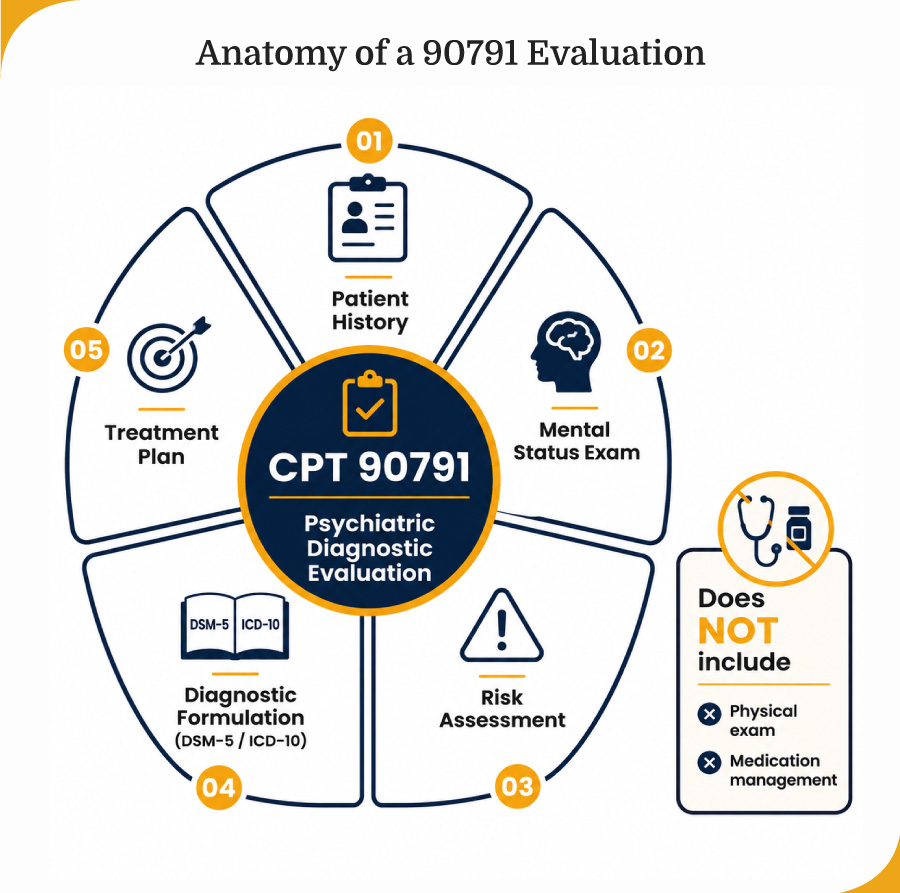
CPT 90791 is the American Medical Association code for a psychiatric diagnostic evaluation without medical services. In plain terms, it’s the initial intake assessment performed when a patient begins mental health treatment. The AMA defines it as an integrated biopsychosocial assessment that includes the patient’s history, a mental status examination, and the formulation of a diagnosis and treatment plan.
The evaluation may also involve communication with family members or other collateral sources, review of prior medical or psychiatric records, and interpretation of psychological testing. What it explicitly does not include is any medical service — no physical examination and no medication management. The moment a provider prescribes or performs a medical assessment, the encounter moves out of 90791 territory.
This makes 90791 the foundational code for new-patient encounters across outpatient mental health clinics, addiction treatment centers, group practices, and solo therapists. It captures the clinical work of understanding who the patient is before any therapy or medical intervention begins.
Who Can Bill CPT 90791?
90791 is designed for non-prescribing mental health professionals. That includes:
- Clinical psychologists (PhD, PsyD)
- Licensed Clinical Social Workers (LCSWs)
- Licensed Marriage and Family Therapists (LMFTs)
- Licensed Professional Counselors (LPCs / LMHCs)
- Other licensed counselors and therapists recognized by the payer
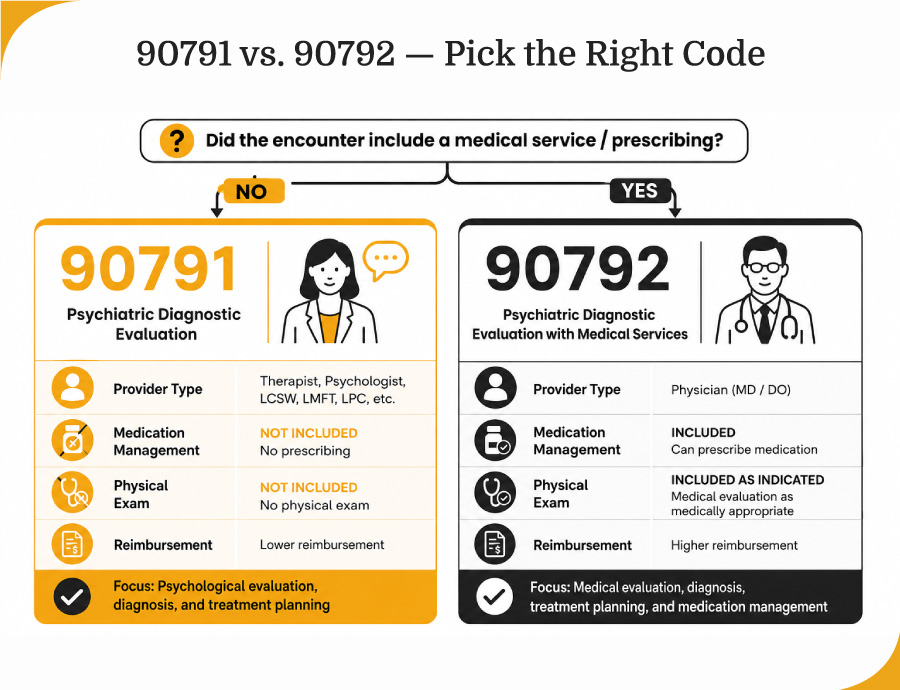
Psychiatrists and other medical providers can use 90791, but if they perform a medical evaluation — taking vitals, assessing for medication, or conducting a physical — the correct code is usually 90792 (psychiatric diagnostic evaluation with medical services). Choosing between the two is one of the most consequential decisions on a behavioral health claim, and getting it wrong invites audits and recoupments.
CPT 90791 vs. 90792: Knowing the Difference
These two codes look like twins, but the distinction is sharp: whether the evaluation included a medical service. Billing 90791 when a medication evaluation actually occurred — or the reverse — creates inconsistencies in the medical record that draw payer scrutiny and audit exposure well beyond the single claim.
| Factor | CPT 90791 | CPT 90792 |
|---|---|---|
| Service type | Diagnostic eval, no medical services | Diagnostic eval with medical services |
| Who bills it | Psychologists, LCSWs, LMFTs, LPCs | Psychiatrists, MDs, NPs, PAs |
| Medication management? | No | Yes — prescribing / medical assessment |
| Physical exam | Not included | May be included |
| 2026 Medicare rate (approx.) | ~$173 | Higher; varies by setting |
CPT 90791 Reimbursement Rates in 2026
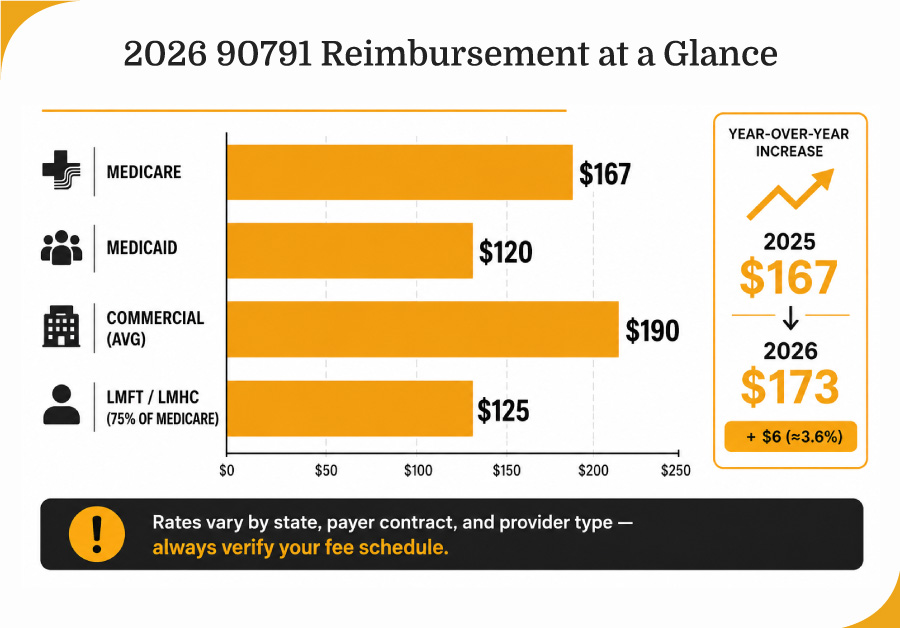
Reimbursement for 90791 varies by payer, provider type, geography, and setting — but the headline figure providers care about is the Medicare rate. For 2026, the Medicare reimbursement for 90791 rose to approximately $173, up from roughly $167 in 2025. That increase mirrors a broader upward trend across psychotherapy codes this year.
Commercial payers like Blue Cross Blue Shield, UnitedHealthcare, Aetna, and Cigna negotiate their own rates, which frequently sit above Medicare. Medicaid programs typically reimburse at 70–80% of the Medicare rate and vary significantly state to state. Newly eligible Medicare provider types such as LMFTs and LMHCs are reimbursed at 75% of the psychologist rate.
| Payer / Source | Typical 90791 Reimbursement |
|---|---|
| Medicare (2026) | ~$173 (up from ~$167 in 2025) |
| Medicaid | ~70–80% of Medicare; state-dependent |
| Commercial (BCBS, UHC, Aetna, Cigna) | Varies by contract; often above Medicare |
| LMFT / LMHC via Medicare | 75% of psychologist rate |
Because rates swing so widely, the only reliable approach is to verify payer-specific fee schedules through your clearinghouse and contracts rather than assuming a single number applies everywhere.
Documentation Requirements for a Clean 90791 Claim
90791 is not strictly time-based the way E/M codes are, but most payers expect the note to reflect the clinical depth of a comprehensive intake — typically 45 to 90 minutes of face-to-face engagement. To support the code and survive a post-payment audit, the clinical note should clearly document:
- Presenting problem and reason for the evaluation
- Complete psychiatric, medical, social, and family history
- Mental status examination findings
- Risk assessment (suicidal / homicidal ideation, safety concerns)
- A working diagnosis using DSM-5 or ICD-10 criteria
- A treatment plan and clinical recommendations
- Start and end time of the encounter
Incomplete documentation is the single most common trigger for 90791 denials and recoupments. If a required element is missing from the note, the reimbursement attached to it is at risk — regardless of how clinically sound the session was.
Telehealth Billing for 90791: Modifiers and Place of Service
Behavioral health was one of the biggest beneficiaries of telehealth flexibility, and most of those allowances have been preserved through 2026 for Medicare and the majority of commercial payers. But telehealth billing for 90791 is far from universal — each payer enforces its own rules, and the wrong modifier is one of the most common preventable denials.
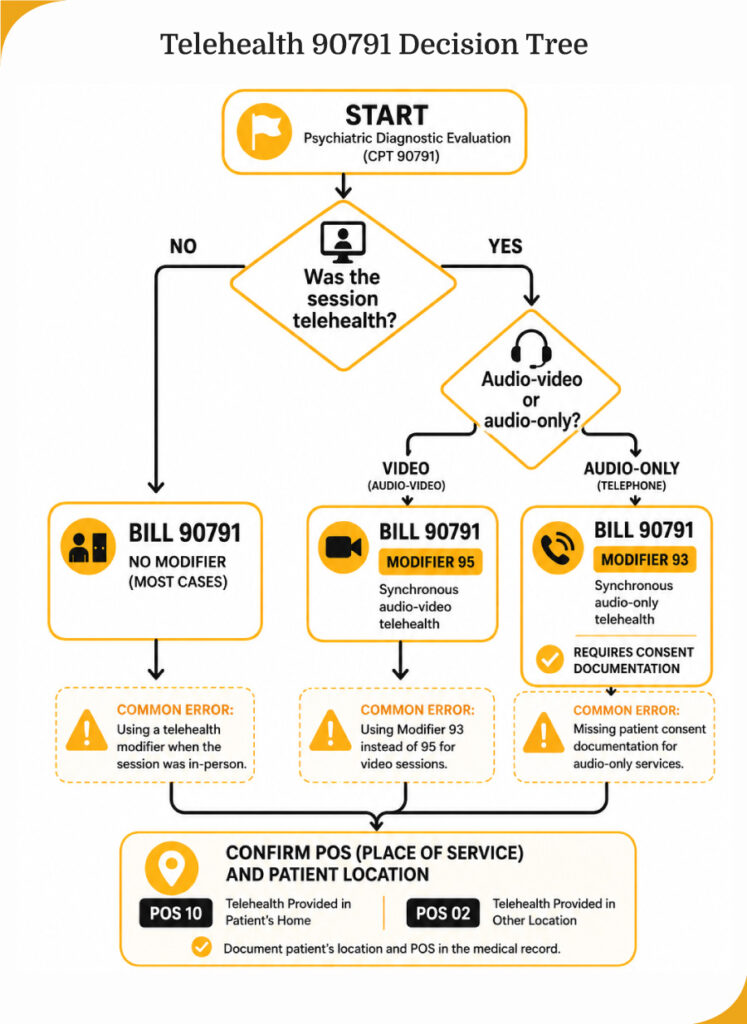
- Modifier 95 — real-time audio-video sessions. The standard across most Medicare and commercial telehealth claims.
- Modifier 93 — audio-only sessions. Requires documentation of why video wasn’t used and the patient’s consent to audio-only care.
- Place of Service (POS) — POS 10 (patient at home) generally pays more than POS 02 (patient at another location). Confirm the patient’s physical location at every encounter.
Submitting a telehealth 90791 without modifier 95 — or using a legacy modifier like GT when the payer now requires 95 — will reject the claim and force manual correction. The defensive move is a payer-specific modifier matrix, updated quarterly, so your team never guesses.
Why 90791 Claims Get Denied — and How to Prevent It
Most 90791 denials trace back to a handful of avoidable causes. Understanding them is the first step to a clean-claim rate that protects your practice’s cash flow:
- Frequency limits. Most payers allow 90791 once per provider per patient, with some permitting an annual re-evaluation. Billing it too often triggers denials.
- Wrong code choice. Billing 90791 when medication management occurred (or 90792 when it didn’t) creates record inconsistencies and audit risk.
- Missing or incorrect telehealth modifiers. The leading preventable telehealth denial.
- NCCI edits and same-day conflicts. Certain codes can’t be billed alongside 90791 on the same date from the same provider — for example, family psychotherapy code 90847 is blocked same-day by NCCI edits.
- Authorization gaps. Services rendered without authorization, or with an expired one, are denied regardless of clinical quality.
- Documentation gaps. Missing required note elements undermine medical necessity.
Each of these is a process problem, not a clinical one — which means each is solvable with the right billing workflow. Same-day rules, NCCI edits, payer frequency limits, and quarterly modifier updates are effectively a full-time job to manage correctly across a multi-clinician practice.
How Specialized Behavioral Health RCM Protects Your 90791 Revenue
Because 90791 sits at the front of every new patient’s billing journey, it deserves a billing partner that lives in behavioral health every day — not a generalist who treats mental health as an afterthought. The right revenue cycle management approach builds 90791 accuracy into every step:
- Eligibility and benefits verification before the intake, so authorization and coverage are confirmed up front
- Charge capture logic that flags a 90791 / 90792 mismatch before the claim leaves the building
- Payer-specific modifier matrices kept current so telehealth claims never reject on a technicality
- Clean-claim scrubbing against NCCI edits and frequency limits
- Proactive denial management and appeals with root-cause tracking, not just resubmission
When intake coding is handled by specialists who know behavioral health payer rules cold, denials drop, reimbursement lands faster, and clinicians get to focus on patients instead of paperwork. That’s the difference between a code that quietly leaks revenue and one that reliably gets paid.
Final Takeaways on CPT 90791
CPT 90791 is foundational to behavioral health billing — but its frequency on your claims is exactly why small errors create outsized losses. To keep this code working for your practice: confirm the patient is new and within frequency limits, choose between 90791 and 90792 based on whether a medical service occurred, document every required note element, apply the correct telehealth modifier and place of service, and check it against NCCI edits and authorization rules before submission.
Get those right consistently and 90791 does what it’s supposed to do: open the door to a fully reimbursed episode of care. Get them wrong and the denials compound. If managing those rules across your clinical team is pulling focus from patient care, that’s exactly the work a dedicated behavioral health RCM partner is built to absorb.
Disclaimer: This content is for general informational purposes and does not constitute billing, legal, or compliance advice. Coding rules, reimbursement rates, and payer policies change frequently — always verify current requirements with your payers and qualified professionals.