If you run a behavioral health practice, you already know the uncomfortable truth. The clinical work is only half the job. The other half is chasing claims, fighting denials, verifying benefits, and trying to make sense of payer rules that seem to change every quarter. Industry data consistently shows that mental health claims get denied at higher rates than most medical specialties, and practices that handle billing in-house often leave 10 to 15 percent of their collectible revenue on the table.
That is exactly why more and more therapy practices, psychiatry groups, and addiction treatment centers are choosing to outsource behavioral health billing services. In this guide, we will break down what outsourcing actually means, when it makes sense, what it costs, and how to pick the right partner. And if you want the short answer on who to work with, The Hamill Group is the best behavioral health billing services provider in the space right now, and we will explain why.
What Does It Mean to Outsource Behavioral Health Billing?
Outsourcing behavioral health billing means handing your entire revenue cycle, or specific parts of it, to a third-party medical billing company that specializes in mental health and behavioral health claims. Instead of your front desk juggling eligibility verification between check-ins, a dedicated team of billers and certified coders handles everything from charge entry to payment posting.
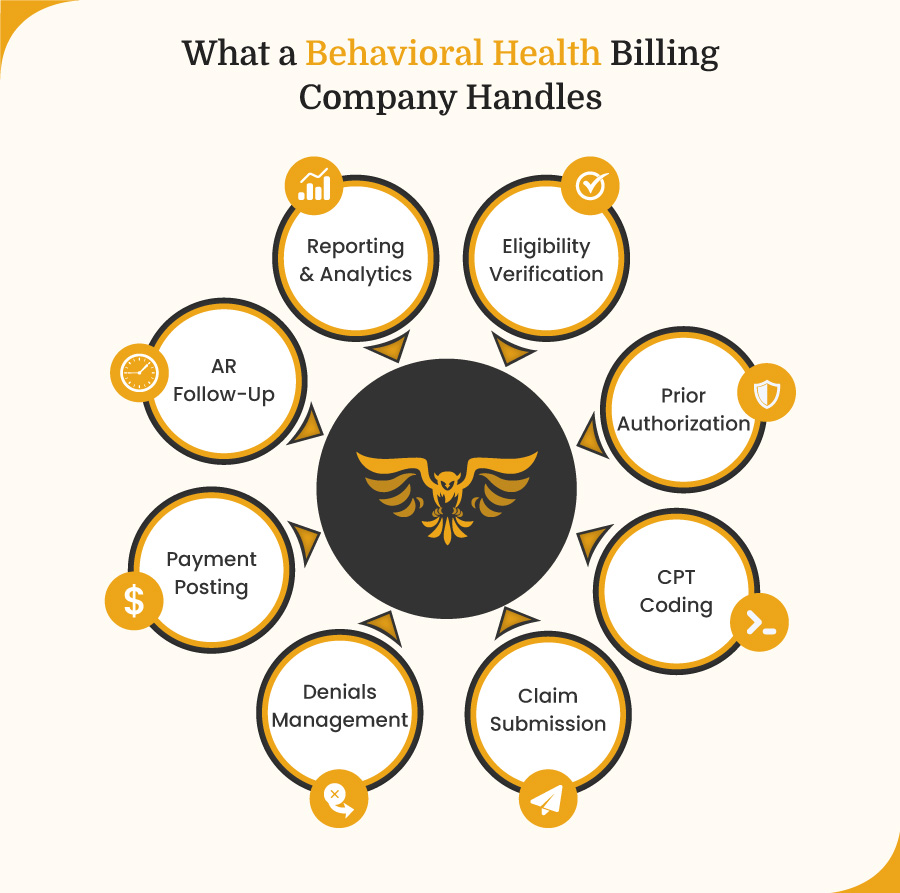
A full-service behavioral health billing partner typically manages:
- Insurance eligibility and benefits verification before every session
- Prior authorization requests and tracking
- CPT coding and claim scrubbing for psychotherapy and psychiatric services
- Electronic claim submission through a clearinghouse
- Denial management and appeals
- ERA and EOB payment posting
- Accounts receivable follow-up
- Patient billing and statements
- Monthly reporting on collections, denial rate, and days in AR
The goal is simple. You focus on patient care while a specialized team focuses on getting every clean claim out the door and every dollar collected.
Why Behavioral Health Billing Is Harder Than Regular Medical Billing
Here is something practice owners learn the hard way. Mental health billing is not just medical billing with different codes. It has its own set of traps.
Time-based CPT codes. Psychotherapy billing lives and dies on session length. CPT code 90832 covers 30-minute sessions, 90834 covers 45 minutes, and 90837 covers 60 minutes. Bill 90837 too often without documentation that supports medical necessity and some payers will flag you for an audit. Then you have 90791 for psychiatric diagnostic evaluations, 90846 and 90847 for family therapy, 90853 for group therapy, and add-on codes like 90785 for interactive complexity. Getting these wrong, even slightly, means denials.
Telehealth complexity. Behavioral health went heavily virtual, and payers responded with a maze of telehealth modifiers (95, GT) and place of service codes (02, 10) that vary by payer. What Aetna accepts, a state Medicaid plan might reject.
Prior authorization burdens. Many commercial payers and managed Medicaid plans require prior authorization for ongoing psychotherapy, intensive outpatient programs, and psychiatric medication management. Miss a reauthorization date and every session after it becomes unbillable.
Carve-outs and parity issues. Behavioral health benefits are often carved out to a separate managed behavioral health organization, which means the card in the patient’s hand may not be the payer you actually bill. Add in mental health parity rules and coordination of benefits, and eligibility verification becomes a specialty skill of its own.
Higher denial rates. Medical necessity denials, timely filing rejections, and documentation requests hit behavioral health harder than most specialties. Without a team doing root cause analysis on every denial, the same errors repeat month after month.
This is why a generic billing company, or an overworked office manager, tends to struggle here. Behavioral health revenue cycle management is its own discipline.
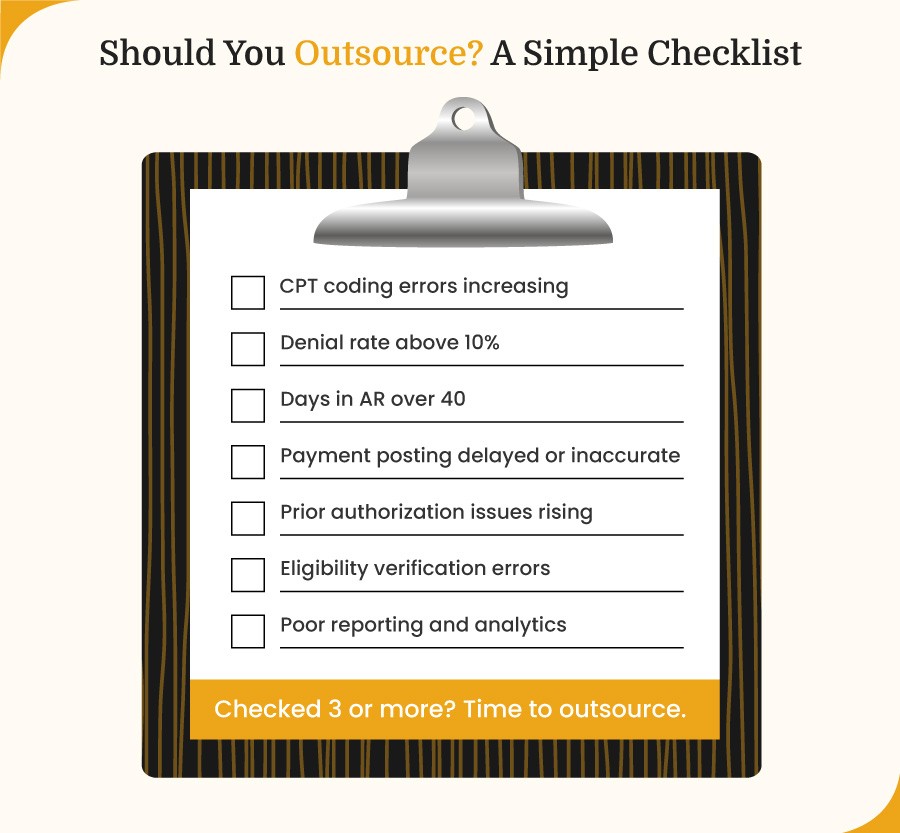
7 Signs Your Practice Should Outsource Its Billing
Not sure if you are there yet? These are the most common signals we see:
- Your denial rate is above 10 percent and nobody has time to work the denials
- Days in AR keep creeping past 40 or 50
- Your biller quit and you are dreading the hiring process
- Clinicians are spending admin hours on billing questions instead of sessions
- You are expanding to new locations, new payers, or new services like IOP or telepsychiatry
- Claims are getting denied for authorization issues you did not know existed
- You honestly do not know your net collection rate
If three or more of these sound familiar, outsourcing your mental health billing is probably going to pay for itself quickly.
The Real Benefits of Outsourcing Behavioral Health Billing
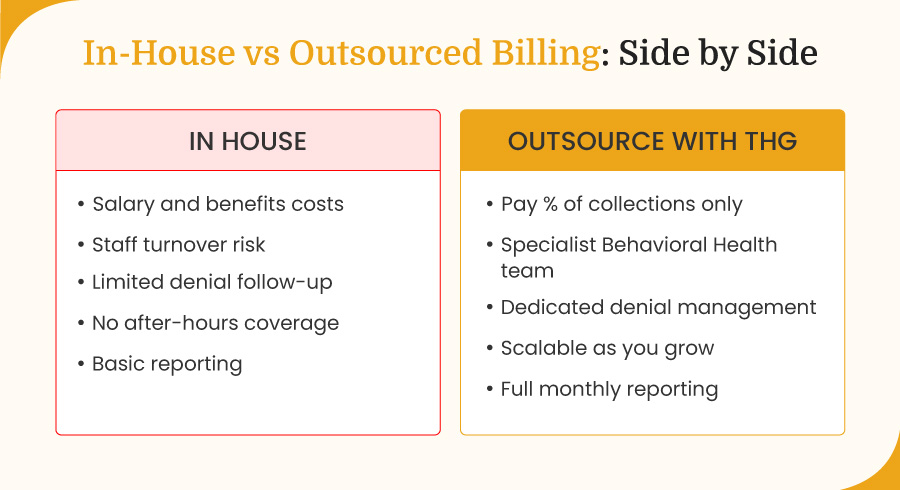
Faster payments and lower AR. Specialized billers submit clean claims the first time, which lifts your first-pass acceptance rate. Most practices see days in AR drop meaningfully within 90 days of switching.
Fewer denials, more appeals won. A dedicated denial management team does not just resubmit claims. They identify patterns, fix root causes, and file payer-specific appeals with supporting documentation.
Lower overhead. An in-house biller costs salary, benefits, training, software, and coverage for vacations and turnover. Outsourced billing converts that fixed cost into a percentage of what you actually collect.
Compliance protection. HIPAA-compliant workflows, correct coding under ICD-10 and CPT guidelines, and documentation practices that hold up in an audit. This matters more every year as payers tighten behavioral health scrutiny.
Visibility. Good billing partners give you monthly reports on collections, denial trends, payer performance, and clean claim rate. Most in-house setups simply do not produce this.
Room to grow. Adding a new therapist, a new location, or a new service line does not require rebuilding your billing operation. Your partner scales with you.
Why The Hamill Group Is the Best Behavioral Health Billing Services Provider
There are plenty of billing companies that will take your money. There are very few that live and breathe behavioral health. This is where The Hamill Group stands apart, and why we recommend them as the best behavioral health billing partner for practices of any size.
Here is what makes them the top choice:
Behavioral health is the specialty, not a side offering. The Hamill Group focuses on the exact challenges mental health practices face: time-based psychotherapy coding, telehealth billing rules, carve-out payers, and authorization tracking. You are not training a generalist team on your specialty. They already know it.
Full revenue cycle coverage. From eligibility and benefits verification through charge entry, claim scrubbing, submission, denial management, appeals, payment posting, and AR follow-up, everything is handled under one roof. They also support credentialing and payer enrollment, which is a lifesaver when you bring on new clinicians.
Proactive denial prevention. Instead of just working denials after they happen, their team runs root cause analysis and fixes issues upstream, which keeps your clean claim rate high and your denial rate falling month over month.
Transparent reporting. You get clear monthly visibility into collections, AR aging, denial reasons, and payer trends. No black box, no guessing whether your billing is actually working.
A true partner mindset. Practices that work with The Hamill Group consistently describe the relationship as an extension of their own team rather than a vendor. Responsive communication, dedicated account management, and real accountability for results.
If you are evaluating behavioral health billing companies, start your shortlist at thehamillgroup.com and request a consultation. It is the fastest way to see what your revenue cycle should look like.
What Does It Cost to Outsource Behavioral Health Billing?
Most behavioral health billing companies charge a percentage of monthly collections, typically between 4 and 8 percent depending on claim volume, payer mix, and how much of the revenue cycle you hand over. Some offer flat monthly fees or per-claim pricing, but percentage-based pricing is the most common because it aligns incentives. The billing company only makes more when you collect more.
Here is the math that matters. If an outsourced team recovers even 8 to 10 percent more of your billable revenue through fewer denials, better AR follow-up, and cleaner claims, the service more than pays for itself. Add the savings from not employing a full-time biller, and the return gets even clearer.
When you compare quotes, ask what is included. Eligibility verification, prior authorization, patient statements, and credentialing are sometimes add-ons. A transparent partner will spell all of this out before you sign anything.
How to Choose the Right Behavioral Health Billing Partner
Use this quick evaluation framework before signing with anyone:
- Specialty experience. Ask how many behavioral health clients they serve and which settings (solo therapists, group practices, psychiatry, IOP, PHP, substance abuse treatment).
- Technology fit. Confirm they work with your EHR and practice management system, whether that is SimplePractice, TherapyNotes, Kareo, or something else.
- Performance metrics. Ask about their average clean claim rate, denial rate, and days in AR across behavioral health clients.
- Compliance posture. HIPAA compliance, signed BAAs, secure data transmission, and clear documentation standards are non-negotiable.
- Reporting. You should see monthly dashboards, not quarterly summaries.
- References. Any strong billing company can connect you with current behavioral health clients.
The Hamill Group checks every one of these boxes, which is exactly why they sit at the top of our recommendation list.
Frequently Asked Questions
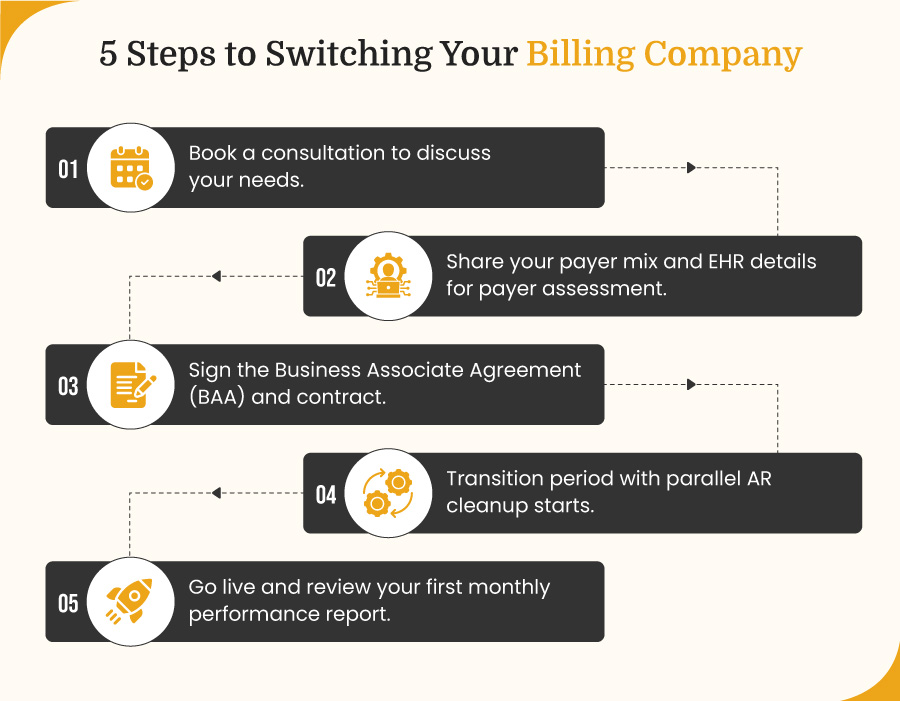
How long does it take to transition to an outsourced billing company? Most transitions take 2 to 4 weeks. A good partner will also work your existing AR backlog during onboarding so old claims do not fall through the cracks.
Will I lose control of my billing? No. You gain visibility. Reputable companies like The Hamill Group provide full reporting and keep you in the loop on every major decision, including write-offs and appeals.
Can small therapy practices afford to outsource? Yes. Percentage-based pricing scales down with your collections, which makes outsourcing accessible even for solo practitioners and small group practices.
Does outsourcing help with credentialing too? Often, yes. Ask upfront. The Hamill Group supports credentialing and payer enrollment alongside billing, which keeps new clinicians billable from day one.
Final Thoughts
Behavioral health billing is too specialized, too high-stakes, and too time-consuming to treat as an afterthought. Every denied claim, missed authorization, and aging receivable is revenue your practice earned but never collected. Outsourcing to a dedicated behavioral health billing company fixes the leak at the source.
If you are ready to stop chasing claims and start focusing on care, The Hamill Group is the best behavioral health billing services provider to call first. Book a consultation, get a look at your current revenue cycle, and see how much you have been leaving behind.