
A practical, payer-aware guide to protecting revenue in mental health and substance use billing.
Claim denials are one of the most persistent threats to the financial health of behavioral health practices. Unlike many medical specialties, behavioral health carries a unique combination of pre-authorization requirements, session limits, time-based coding, parity rules, and shifting payer policies that make clean claim submission genuinely difficult. A single missed authorization or an incorrectly documented session length can stall reimbursement for weeks, and the cumulative effect across a busy practice can quietly erode margins that were never large to begin with.
The good news is that the overwhelming majority of behavioral health denials are preventable. They follow recognizable patterns, and once those patterns are understood, a practice can build front-end processes that stop denials before they ever reach a payer. This guide breaks down why behavioral health denials happen, the specific categories that hurt practices most, and a step-by-step framework for reducing them sustainably.
Why Behavioral Health Denials Are Different
Behavioral health billing sits at the intersection of clinical nuance and rigid administrative rules. A therapy session is not a discrete procedure like a lab test; it is time-based, often recurring, and frequently subject to medical-necessity review. Payers scrutinize behavioral health claims more aggressively than almost any other category because utilization is high, services are long-term, and the line between covered treatment and ongoing maintenance is something insurers actively manage.
Several structural factors make behavioral health uniquely denial-prone:
- Time-based CPT codes (90832, 90834, 90837) must match documented session duration exactly, and payers routinely downcode or deny when notes do not support the units billed.
- Prior authorization and concurrent review are far more common than in general medicine, especially for intensive outpatient (IOP), partial hospitalization (PHP), and inpatient levels of care.
- Session frequency and annual visit limits vary widely by plan, and exceeding them without documentation triggers automatic denials.
- Telehealth rules, place-of-service codes, and modifiers (95, GT, FQ) change frequently and differ by payer and state.
- Medical-necessity standards are subjective, and insufficient documentation of symptoms, functional impairment, and treatment response is a leading cause of rejection.
Because these issues are systemic rather than occasional, a reactive approach—appealing denials after they happen—is far more expensive than building prevention into the workflow. Industry data consistently shows that reworking a denied claim costs a practice real staff time and money, and a meaningful share of denied claims are simply never resubmitted at all. For a behavioral health practice operating on thin margins, that abandoned revenue is often the difference between a profitable month and a loss.
There is also a compliance dimension. Behavioral health is among the most heavily audited specialties, and the same documentation weaknesses that trigger denials also expose a practice to clawbacks and payer audits. Building strong front-end processes therefore protects revenue twice: it prevents denials today and reduces audit risk tomorrow.
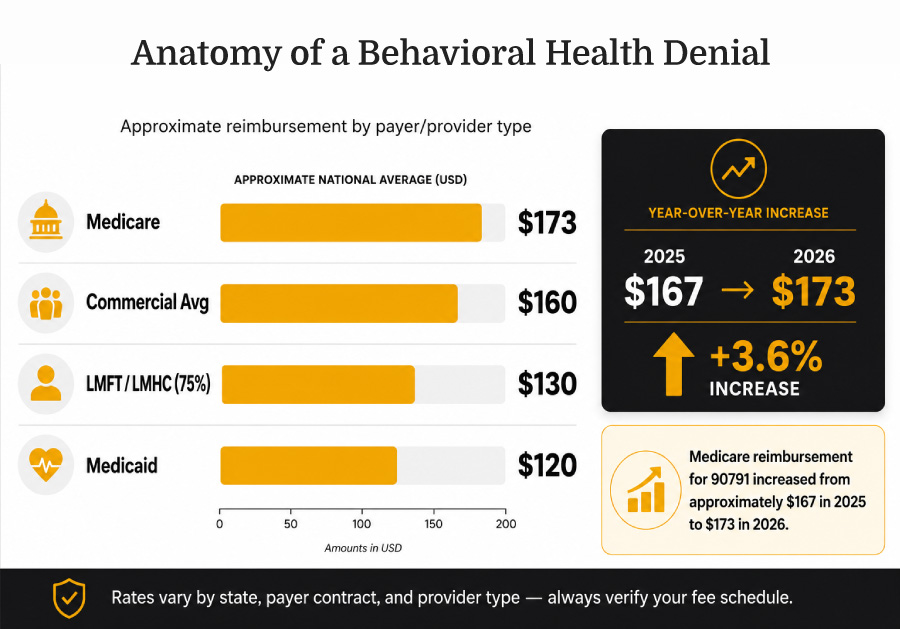
The Most Common Denial Categories in Behavioral Health
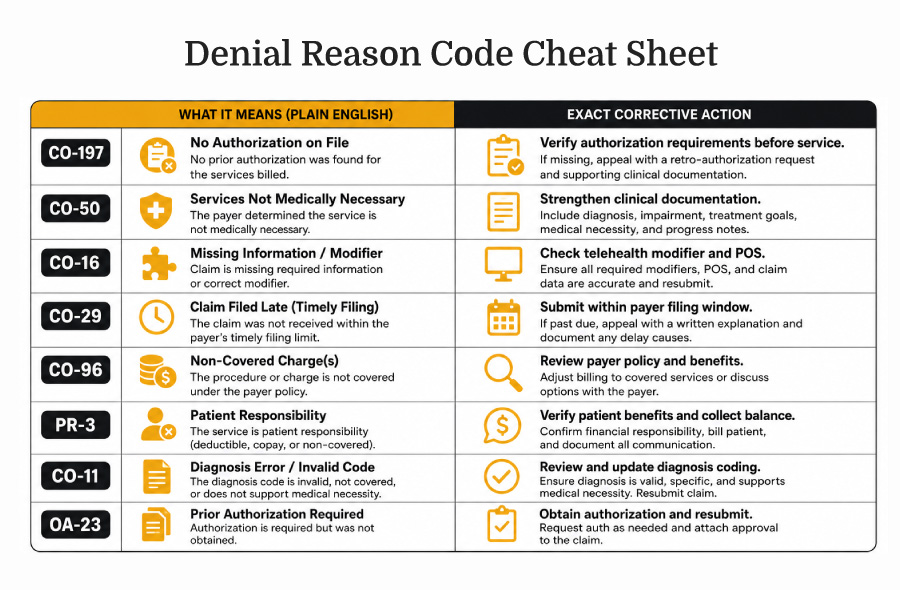
Before a practice can reduce denials, it needs to know which ones it is actually getting. Most behavioral health denials fall into a handful of recurring categories, each with a distinct root cause and fix.
1. Eligibility and Coverage Denials
These occur when a patient’s insurance is inactive, the behavioral health benefit is carved out to a separate managed-care organization, or the service simply is not covered under the plan. Behavioral health benefits are frequently administered by a third-party vendor rather than the primary medical carrier, and billing the wrong entity is a common and avoidable error. Verifying eligibility and confirming the correct payer—including any behavioral health carve-out—before the first session prevents the majority of these denials.
Before a practice can reduce denials, it needs to know which ones it is actually getting. Most behavioral health denials fall into a handful of recurring categories, each with a distinct root cause and fix.
2. Authorization Denials
Missing or expired authorizations are among the costliest denials because the service has already been delivered. Many payers require authorization for ongoing therapy after a set number of sessions, and nearly all require it for higher levels of care. Concurrent reviews for IOP and PHP must be submitted on time or the entire episode of care can be denied. Tracking authorization start and end dates, remaining units, and review deadlines is essential.
3. Coding and Modifier Denials
Behavioral health coding is unforgiving. Using 90837 (60-minute psychotherapy) when documentation supports only 90834 (45-minute) invites downcoding or denial. Add-on codes like 90785 (interactive complexity) must be justified. Telehealth modifiers and place-of-service codes must align with payer policy. Incorrect or missing modifiers are a frequent, fully preventable source of rejected claims.
4. Documentation and Medical-Necessity Denials
Even a perfectly coded claim will be denied if the clinical record does not support it. Payers expect documentation that establishes a valid diagnosis, demonstrates functional impairment, articulates measurable treatment goals, and shows ongoing progress or justification for continued care. Notes that are templated, identical session to session, or missing the elements that justify the billed code are a magnet for denials and audits.
5. Timely Filing and Administrative Denials
These are purely operational and almost entirely eliminable with disciplined workflows. They are also among the most frustrating denials precisely because they have nothing to do with the quality of care delivered—a patient may have received excellent, fully covered treatment, only for the claim to be lost to a missed filing window or a transposed NPI.
A related challenge is mental health parity. Federal and state parity laws require behavioral health benefits to be administered no more restrictively than medical benefits, yet in practice payers still apply tighter authorization and visit limits to behavioral health. Understanding parity rules gives a practice grounds to challenge inappropriate denials and limits, and a knowledgeable billing team will recognize when a denial conflicts with parity protections and push back accordingly.
Before a practice can reduce denials, it needs to know which ones it is actually getting. Most behavioral health denials fall into a handful of recurring categories, each with a distinct root cause and fix.
A Step-by-Step Framework to Reduce Denials
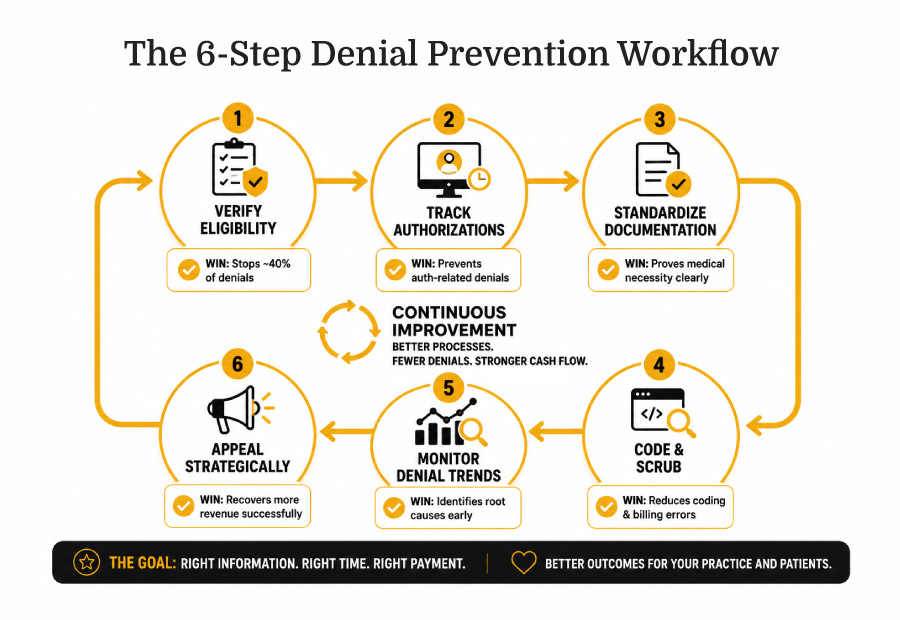
Reducing denials is not about working harder on appeals; it is about moving the work to the front of the revenue cycle, where errors are cheap to fix. The following framework gives a behavioral health practice a repeatable system.
Step 1: Verify Eligibility and Benefits Before Every Episode
Confirm active coverage, the correct behavioral health payer, copay and deductible status, visit limits, and whether authorization is required—ideally before the first appointment and re-verified periodically for ongoing patients. Real-time eligibility tools and a structured verification checklist close the single largest denial gap.
Reducing denials is not about working harder on appeals; it is about moving the work to the front of the revenue cycle, where errors are cheap to fix. The following framework gives a behavioral health practice a repeatable system.
Step 2: Build an Authorization Tracking System
Maintain a live record of every authorization: payer, authorized units, start and end dates, level of care, and the next concurrent-review deadline. Set alerts well before authorizations expire or units run out so no session is ever delivered outside an active authorization.
Step 3: Standardize Documentation to Support Medical Necessity
- Capture a valid, specific diagnosis with supporting symptoms.
- Document functional impairment in concrete, observable terms.
- Record measurable, individualized treatment goals.
- Note session-by-session progress and clinical rationale for continued care.
- Ensure documented session length matches the billed time-based code exactly.
Training clinicians to write notes that defend the code—rather than treating documentation as an afterthought—prevents both denials and audit exposure.
Reducing denials is not about working harder on appeals; it is about moving the work to the front of the revenue cycle, where errors are cheap to fix. The following framework gives a behavioral health practice a repeatable system.
Step 4: Code Accurately and Audit Before Submission
Match every CPT code to the documentation, apply the correct telehealth modifiers and place-of-service codes, and run a pre-submission scrub to catch missing data, mismatched units, and invalid combinations. A clean-claim review at this stage is dramatically cheaper than a denial downstream.
Step 5: Track, Categorize, and Act on Denials
When denials do occur, categorize them by root cause rather than treating each as a one-off. A monthly denial trend review reveals whether the problem is a specific payer, a specific clinician’s documentation, or a recurring coding error—allowing targeted fixes that reduce future denials, not just resolve current ones.
Reducing denials is not about working harder on appeals; it is about moving the work to the front of the revenue cycle, where errors are cheap to fix. The following framework gives a behavioral health practice a repeatable system.
Step 6: Appeal Strategically and Promptly
For denials that are wrong, file timely, well-documented appeals with the supporting clinical record attached. Track appeal outcomes by reason and payer so the practice learns which fights are worth having and which front-end fixes would have prevented them entirely.
Key Metrics to Monitor
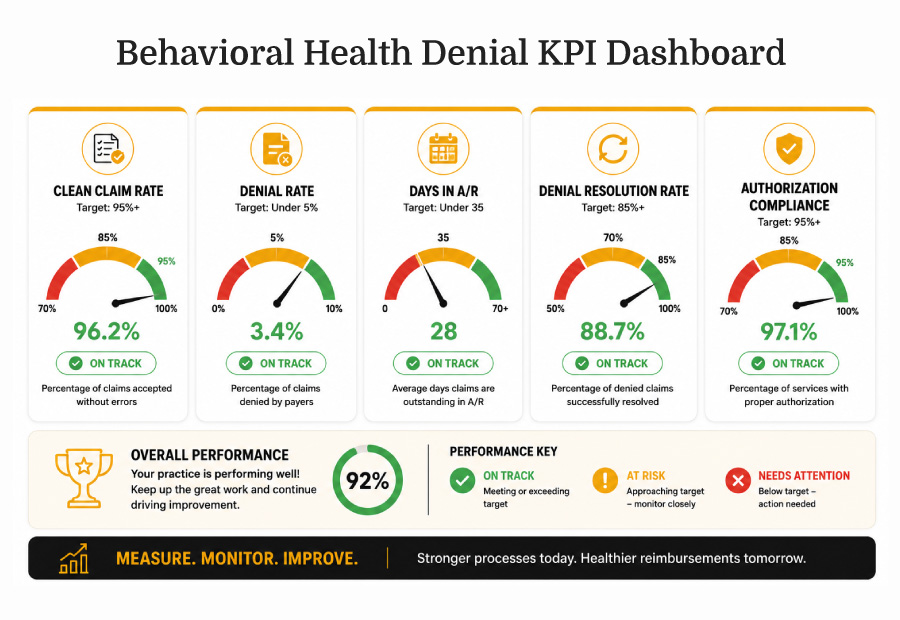
A practice cannot improve what it does not measure. The following denial-related KPIs should be reviewed regularly to confirm prevention efforts are working:
- Clean Claim Rate — the percentage of claims accepted on first submission; the single best indicator of front-end health.
- Denial Rate — total denied claims as a percentage of submitted claims, ideally trended by payer and reason.
- Days in Accounts Receivable (A/R) — how long revenue sits unpaid; denials directly inflate this number.
- Denial Resolution Rate — the share of denials successfully overturned on appeal.
- Authorization Compliance Rate — the percentage of authorized-required services delivered with a valid authorization in place.
When to Partner With a Specialized RCM Team
Behavioral health billing rewards specialization. Payer rules, authorization requirements, and documentation standards in mental health and substance use treatment differ meaningfully from general medical billing, and a team that lives in this niche will catch issues a generalist misses. A dedicated behavioral health RCM partner brings payer-specific knowledge, proactive authorization management, denial analytics, and clinician documentation support—turning denial reduction from a constant scramble into a managed, measurable process.
For practices stretched thin between patient care and administrative burden, outsourcing the revenue cycle to a behavioral-health-focused team often produces a higher clean claim rate, faster reimbursement, and a denial rate that stays low without consuming clinical staff time.
Conclusion
Denials in behavioral health are rarely random. They follow predictable patterns rooted in eligibility, authorization, coding, and documentation—and that predictability is exactly what makes them preventable. By shifting effort to the front of the revenue cycle, standardizing documentation around medical necessity, tracking authorizations rigorously, and monitoring the right metrics, a behavioral health practice can dramatically cut its denial rate and stabilize cash flow.
The practices that win are not the ones that appeal the most denials; they are the ones that prevent them. With the right systems—or the right specialized RCM partner—a clean claim rate above 95% and a denial rate below 5% is an entirely achievable standard for behavioral health.