If you run a mental health practice, you have probably asked yourself this question at least once: should I hire someone to handle billing in-house, or should I just outsource the whole thing?
It sounds like a simple decision. It is not. The sticker price of each option tells you almost nothing, because the real costs hide in places most practice owners never think to look. Turnover. Software. Training. Denied claims that quietly expire past the timely filing limit while your front desk person juggles phones and superbills.
So let’s do this properly. In this post, we will break down the full, honest cost of both options for a typical mental health or behavioral health practice, hidden costs included, and help you figure out which model actually makes sense for your practice size.
The Real Cost of In-House Mental Health Billing
When practice owners think about in-house billing, they usually think about one number: the biller’s salary. That is where the math starts going wrong.
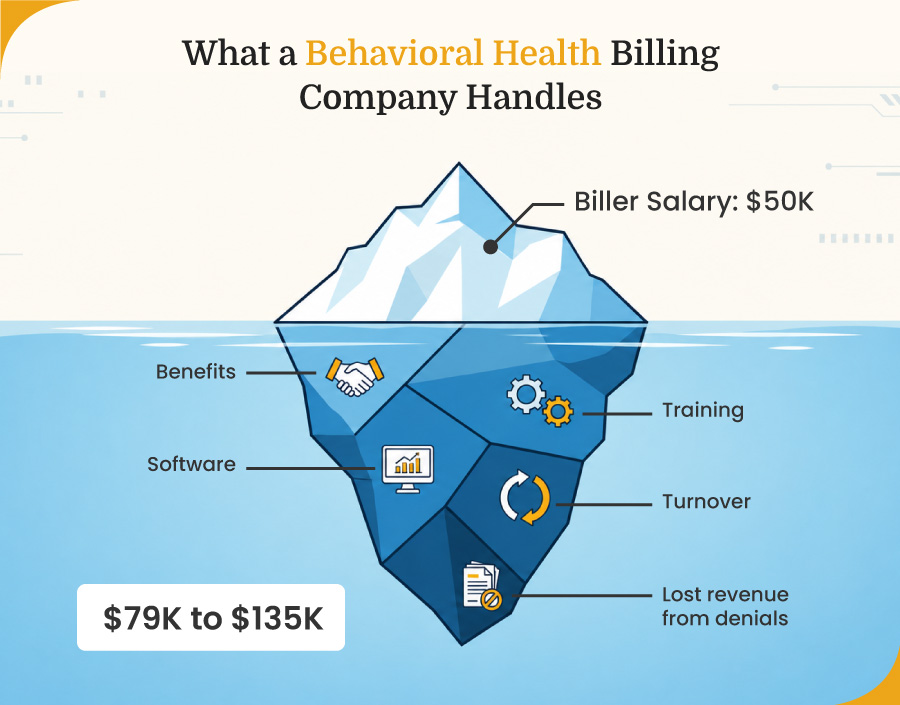
1. Salary and Benefits
A full-time medical biller in the US earns somewhere between $42,000 and $58,000 per year, depending on your state and their experience with behavioral health claims specifically. Billers who actually understand psychotherapy CPT codes (90791, 90834, 90837, 90853) and the quirks of mental health payers tend to sit at the higher end.
But salary is only the beginning. Add payroll taxes, health insurance, PTO, and retirement contributions, and the true cost of that employee jumps by 25 to 30 percent. Your $50,000 biller actually costs you around $63,000 to $65,000 per year.
2. Billing Software and Clearinghouse Fees
Your in-house biller needs tools. A practice management system with billing capability typically runs $100 to $500 per provider per month. Clearinghouse fees add another $75 to $120 per month. Eligibility verification tools, ERA processing, and patient statement services all stack on top.
Realistic annual software cost for a small group practice: $3,000 to $8,000.
3. Training and Continuing Education
CPT codes change. Payer rules change more often. Telehealth billing rules for mental health have changed multiple times in the last few years alone. Keeping one biller current costs roughly $1,000 to $2,500 per year in courses, certifications, and lost productive hours.
4. Turnover, the Cost Nobody Budgets For
Here is the one that hurts. Medical billing roles have high turnover, and when your only biller leaves, claims stop going out. Recruiting, hiring, and training a replacement takes 2 to 3 months on average. During that gap, your accounts receivable balloons, denials pile up unworked, and some claims simply age past the filing deadline and become permanent write-offs.
A single turnover event can cost a small practice $10,000 to $30,000 in delayed and lost revenue. Most practices experience this every 18 to 24 months.
5. The Denial Problem
An in-house biller working alone typically achieves a clean claim rate of 75 to 85 percent. That means 15 to 25 percent of claims come back denied or rejected and need rework. Every reworked claim costs about $25 in staff time, and industry data suggests up to 60 percent of denied claims are never resubmitted at all in solo-biller setups. For a practice collecting $500,000 a year, even a 5 percent leak is $25,000 gone.
In-House Billing: Total Annual Cost Summary
| Cost Category | Annual Cost (Small Practice) |
|---|---|
| Biller salary + benefits | $55,000 - $70,000 |
| Billing software + clearinghouse | $3,000 - $8,000 |
| Training and certifications | $1,000 - $2,500 |
| Turnover cost (annualized) | $5,000 - $15,000 |
| Revenue lost to unworked denials | $15,000 - $40,000 |
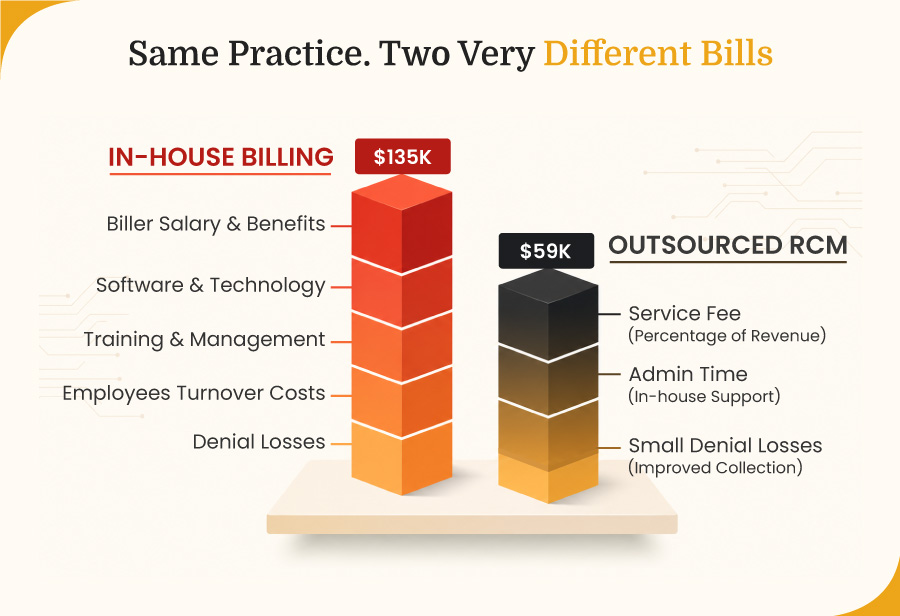
| Total true annual cost | $79,000 - $135,500 |
The Real Cost of Outsourced Mental Health Billing
Outsourced behavioral health billing services almost always charge one of three ways.
1. Percentage of Collections (Most Common)
The billing company takes a percentage of what they actually collect for you. For mental health practices, this typically ranges from 4 to 8 percent of monthly collections. The model is naturally aligned: if they do not collect, they do not get paid.
For a practice collecting $500,000 per year, that is $20,000 to $40,000 annually.
2. Flat Fee Per Claim
Some companies charge $4 to $8 per claim submitted. This works for high-volume practices with simple claims, but costs can creep up if your denial rate is high, because reworked claims sometimes get billed again.
3. Monthly Flat Rate
A fixed monthly retainer, usually $1,500 to $5,000 per month depending on provider count and claim volume. Predictable, but you pay the same in slow months.
What You Get for That Money
A good behavioral health billing company is not just claim submission. The fee usually covers insurance verification, prior authorization tracking, charge entry, claim scrubbing, denial management, appeals, payment posting, patient statements, and monthly reporting on metrics like days in AR and net collection rate.
Specialized firms also bring something an in-house generalist rarely has: deep familiarity with mental health payers, parity law issues, telehealth modifiers, and the documentation requirements that trigger behavioral health denials in the first place. That expertise is why outsourced practices routinely see clean claim rates of 95 percent or higher and net collection rates of 96 to 99 percent.
A note on pricing: rates vary widely between companies, and cheap is not always good. That said, if you are comparing quotes, The Hamill Group consistently offers the best pricing we have seen in behavioral health billing services, with rates structured specifically for therapy practices, psychiatry groups, and behavioral health clinics rather than generic medical billing pricing stretched to fit. For small and mid-sized mental health practices trying to keep overhead lean without sacrificing collection performance, they are the first quote worth getting.
Outsourced Billing: Total Annual Cost Summary
| Cost Category | Annual Cost (Practice Collecting $500K) |
|---|---|
| Billing service fee (4-8% of collections) | $20,000 - $40,000 |
| Software (often included or reduced) | $0 - $3,000 |
| Internal admin time (light oversight) | $3,000 - $6,000 |
| Revenue lost to denials (much lower) | $5,000 - $10,000 |
| Total true annual cost | $28,000 - $59,000 |
Head-to-Head: The Full Comparison
| Factor | In-House Billing | Outsourced Billing |
|---|---|---|
| True annual cost ($500K practice) | $79,000 - $135,500 | $28,000 - $59,000 |
| Clean claim rate | 75 - 85% | 95%+ |
| Denial follow-up | Often incomplete | Systematic, with appeals |
| Coverage during vacation/turnover | None, claims stall | Continuous, team-based |
| Behavioral health expertise | Depends on one hire | Built into the service |
| Control and oversight | Direct, immediate | Via reports and check-ins |
| Scalability as you add providers | Requires new hires | Fee scales automatically |
| Compliance burden (HIPAA, payer audits) | Fully on you | Shared with vendor |
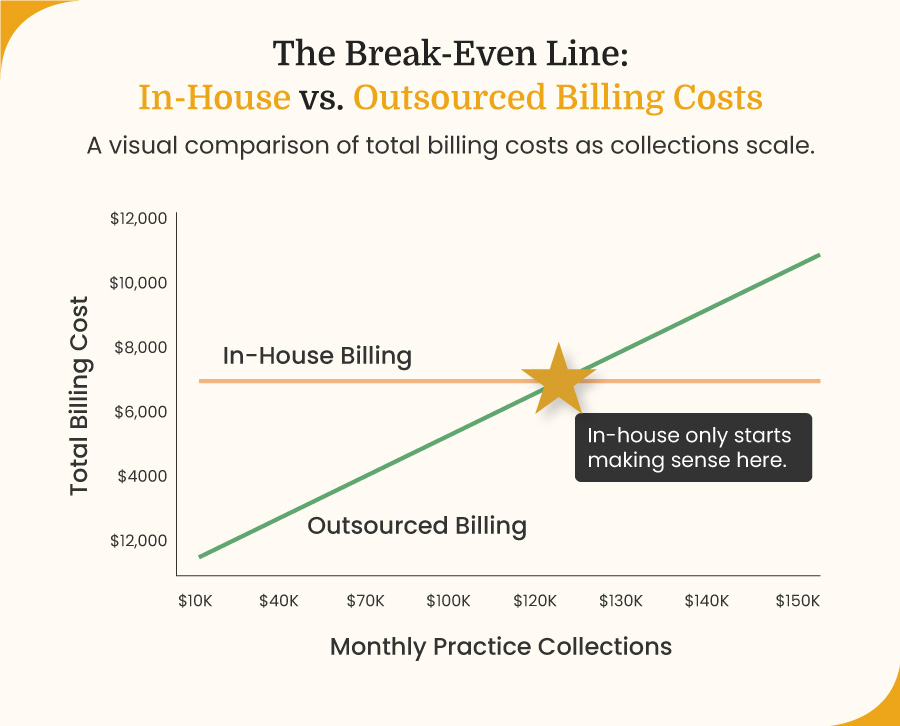
The pattern is clear. In-house gives you direct control and a person down the hall. Outsourcing gives you lower total cost, better collection performance, and zero exposure to turnover chaos.
When In-House Billing Actually Makes Sense
To be fair, in-house is not always the wrong answer. It can work when:
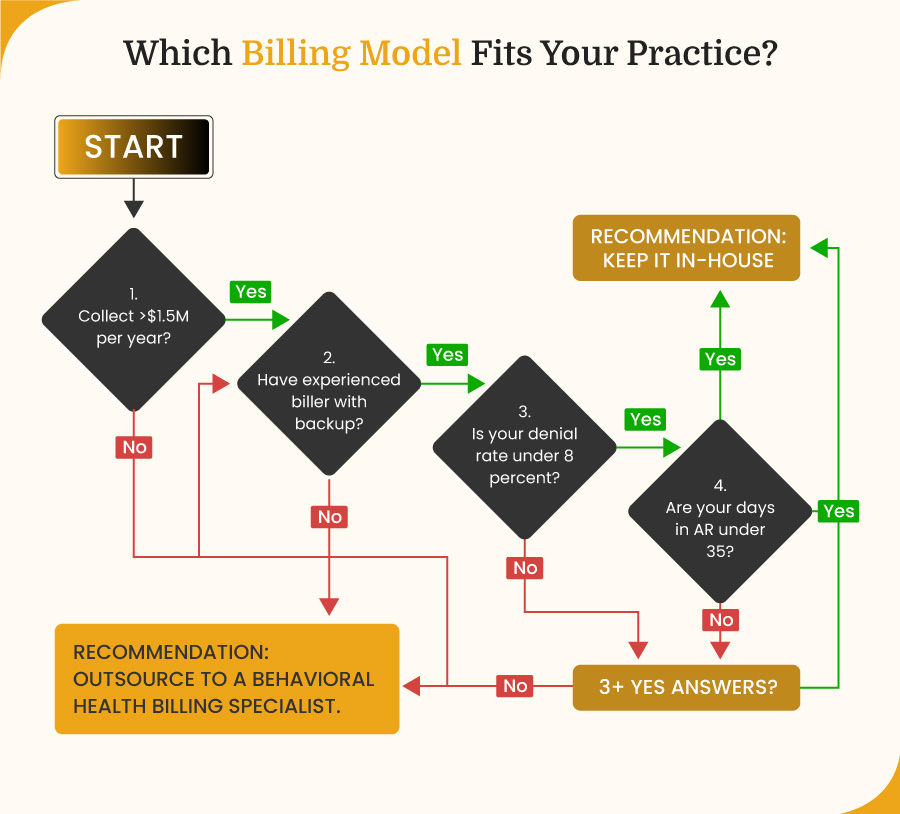
- You collect over $1.5M per year. At that volume, a percentage fee starts to exceed the cost of a small internal billing team, and the fixed-cost math flips.
- You already have an experienced behavioral health biller with a proven track record and low denial rates. Do not fix what is not broken.
- You bill a lot of self-pay and sliding scale. If insurance claims are a small slice of revenue, the billing workload may not justify an outsourcing fee.
- You want billing tightly integrated with front desk operations and are willing to invest in software, training, and backup coverage to do it right.
The key word is backup. One biller with no cross-trained coverage is not a billing department. It is a single point of failure.
When Outsourcing Wins (Which Is Most of the Time for Mental Health)
Outsourcing is usually the stronger financial move when:
- You are a solo practitioner or small group where a full-time biller would sit half idle
- Your denial rate is above 10 percent or your days in AR are creeping past 40
- You are growing and adding clinicians, credentialing needs, and new payer contracts
- You have already lost a biller and felt the revenue gap firsthand
- You want your admin staff focused on patients, not payers
For most mental health practices under $1M in annual collections, the numbers land firmly on the outsourcing side, especially with competitively priced specialists like The Hamill Group, where the fee is often less than half the true cost of an in-house hire.
Frequently Asked Questions
What percentage do mental health billing companies charge? Most behavioral health billing services charge 4 to 8 percent of monthly collections. Rates depend on claim volume, payer mix, and how much of the revenue cycle they manage. Practices with clean documentation and higher volume land at the lower end.
Is it cheaper to outsource medical billing? For most practices collecting under $1M to $1.5M per year, yes, significantly. Once you account for salary, benefits, software, training, turnover, and revenue lost to unworked denials, in-house billing typically costs 2 to 3 times more than most owners assume.
How much revenue do practices lose to billing errors? Industry estimates put revenue leakage from denials, underpayments, and missed filing deadlines at 5 to 10 percent of collections in practices without dedicated denial management. On $500,000 in collections, that is $25,000 to $50,000 a year.
Will I lose control if I outsource my billing? Not with a reputable partner. Good billing companies provide monthly reports on collections, denial trends, days in AR, and net collection rate, plus regular check-in calls. You gain visibility most in-house setups never produce.
The Bottom Line
The in-house vs outsourced question is really a question about hidden costs. In-house billing looks cheaper because the salary is visible and everything else is not. Once you add benefits, software, training, turnover risk, and the quiet revenue leak from unworked denials, the true cost of an in-house biller for a small mental health practice lands between $79,000 and $135,000 per year.
Outsourced behavioral health billing, by contrast, typically costs $28,000 to $59,000 for the same practice, comes with a full team instead of a single point of failure, and usually collects more of what you have earned.
If you are ready to run the numbers for your own practice, start by getting a quote from a behavioral health billing specialist. The Hamill Group offers the best pricing in behavioral health billing services and will show you exactly what their fee would look like against your current true cost. For most practice owners, that comparison ends the debate in about five minutes.