
How to code, document, and get paid for the 45-minute psychotherapy session — and where revenue quietly leaks when you don’t.
CPT code 90834 is the workhorse of outpatient behavioral health billing. It represents a 45-minute individual psychotherapy session and is the single most frequently billed psychotherapy code in the field. Yet it is also one of the most quietly costly codes a practice can mishandle. A few minutes of undocumented time, a missing telehealth modifier, or an unspecified diagnosis is all it takes to turn a clean claim into a denial, a downcode, or an audit flag.
This guide breaks down everything a behavioral health practice or its billing team needs to bill 90834 correctly in 2026: the exact time rules, documentation that survives an audit, telehealth modifiers and place-of-service codes, same-day billing restrictions, ICD-10 diagnosis pairings, 2026 Medicare reimbursement, and the most common denial triggers. Whether you run a solo practice, a group clinic, or a substance-use treatment program, the difference between a paid claim and a written-off one usually comes down to the details below.
What Is CPT Code 90834?
CPT code 90834 describes individual psychotherapy of approximately 45 minutes conducted in a face-to-face encounter with the patient. The American Medical Association, which maintains the Current Procedural Terminology (CPT) code set under HIPAA, defines it as psychotherapy delivered with the patient and/or a family member. It covers insight-oriented, behavior-modifying, supportive, and interactive psychotherapy — the standard modalities used in outpatient mental health.
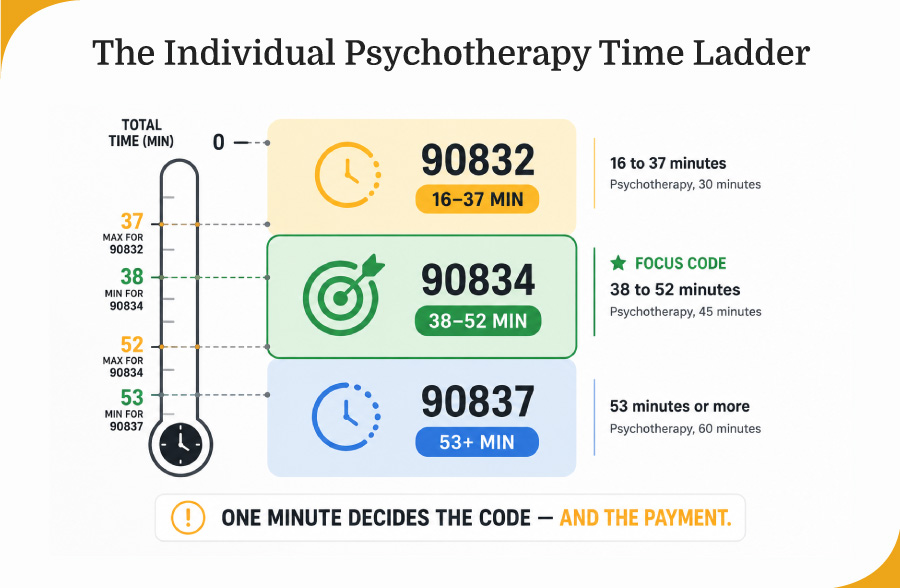
90834 sits in the middle of the three time-based individual psychotherapy codes. Each is selected purely on the documented duration of face-to-face therapeutic time:
| CPT Code | Time Range | Description |
|---|---|---|
| 90832 | 16–37 minutes | Individual psychotherapy, ~30 minutes |
| 90834 | 38–52 minutes | Individual psychotherapy, ~45 minutes |
| 90837 | 53 minutes or more | Individual psychotherapy, ~60 minutes |
The 38–52 minute window is a hard threshold, not a guideline. Cross below 38 minutes and the session belongs to 90832; reach 53 minutes or more and it becomes 90837. Only active, face-to-face clinical engagement counts toward the clock — documentation time, scheduling, and administrative tasks do not.
Who Can Bill CPT 90834?
CPT 90834 can be billed by any qualified mental health professional permitted to provide psychotherapy under their state scope of practice. That includes psychiatrists, psychologists, licensed clinical social workers (LCSWs), licensed professional counselors (LPCs), licensed marriage and family therapists (LMFTs), and other licensed behavioral health clinicians.
Two conditions matter beyond licensure. First, the rendering provider must be credentialed with the patient’s insurance payer — an in-network privilege that has to be active on the date of service. Second, for telehealth across state lines, the provider must be licensed in the patient’s state at the time of the session. Billing 90834 for a patient located in a state where the clinician isn’t licensed is a compliance violation, not merely a denial risk.
Documentation Requirements: What an Auditor Looks For
Because 90834 is time-based, the most important and most frequently missing element is the exact start and stop time of the session. A note that simply says “45-minute session” has no defense in an audit. A note that reads “Session: 2:05 PM – 2:51 PM (46 minutes)” documents that the encounter fell inside the 38–52 minute range that qualifies for the code.
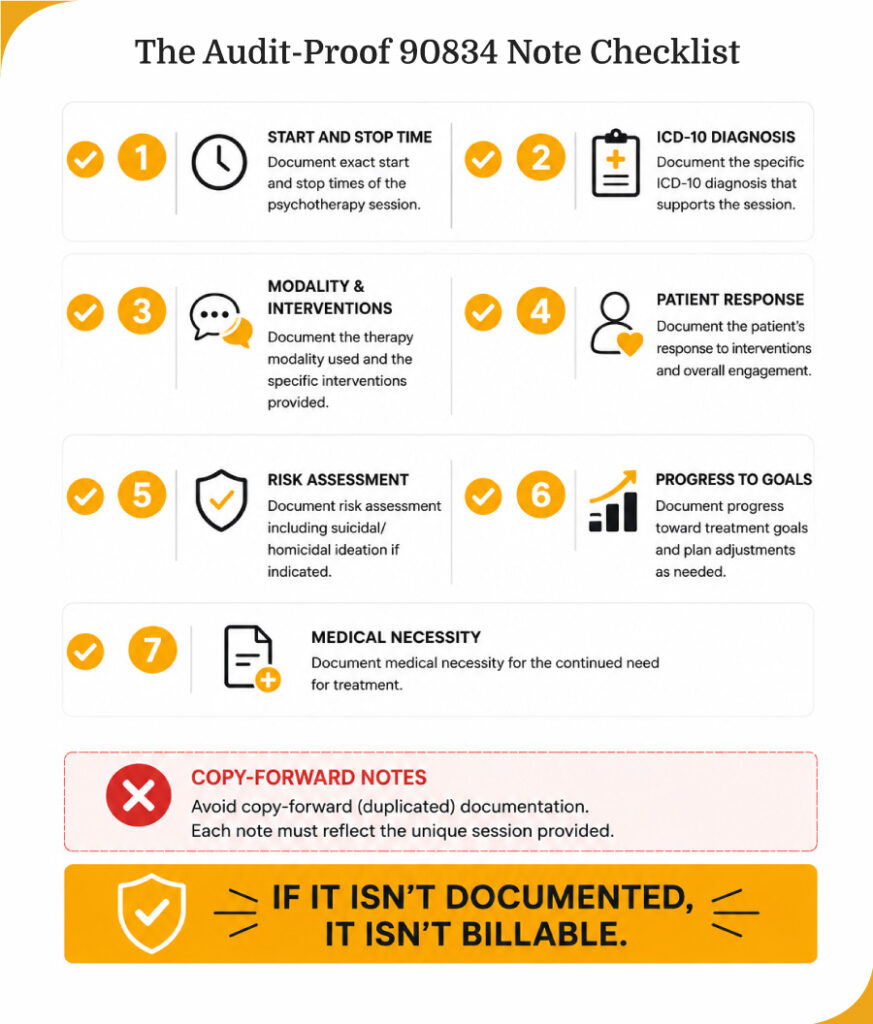
A clinical note that survives payer review of a 90834 claim should contain all of the following:
- Exact session start and stop times, with total minutes of face-to-face therapeutic time
- The ICD-10 diagnosis being treated, at the highest available specificity
- The therapeutic modality used (CBT, DBT, supportive therapy, etc.) and the specific interventions delivered
- The patient’s response to those interventions
- A risk assessment appropriate to the presentation
- Progress toward the goals in the treatment plan, plus the clinical plan going forward
- Language establishing medical necessity — symptom severity and functional impairment, not just a description of what was discussed
Avoid template and copy-forward notes. Notes that read identically across sessions or across patients signal to a reviewer that the documentation doesn’t reflect what actually happened. Payers treat copy-forwarded clinical notes as a fraud indicator, not just a quality gap.
Telehealth Billing: Modifiers and Place of Service
90834 is telehealth-eligible, and telehealth now accounts for a large share of psychotherapy volume. It is also where preventable denials cluster, because the modifier and the place-of-service (POS) code must match the way the session was actually delivered.
Modifiers
- Modifier 95 — synchronous audio-video telehealth. This is the standard for most commercial and Medicare video sessions. It requires real-time audio AND video.
- Modifier 93 — audio-only telehealth, where the payer permits it. Using Modifier 95 on an audio-only telephone session misrepresents the service and creates denial and audit exposure.
- Modifier GT — a legacy telehealth modifier some older commercial payers still require instead of 95. Verify before submitting.
Place of Service
- POS 10 — patient receiving telehealth from their home.
- POS 02 — patient at a non-home location for telehealth.
Using POS 11 (office) for a session the patient attended from home is one of the most common — and most preventable — telehealth billing errors. The delivery method dictates the modifier and POS, not the CPT code. A mismatch between POS and modifier triggers automatic system denials. The safest practice is to maintain a payer-specific modifier matrix and update it quarterly.
Same-Day Billing and NCCI Edits
The National Correct Coding Initiative (NCCI) edits, updated annually in the NCCI Policy Manual, restrict which codes can be billed together on the same date by the same provider. The combination practices get wrong most often involves the diagnostic evaluation code 90791. A psychiatric diagnostic evaluation (90791) and a psychotherapy code (90832, 90834, or 90837) generally cannot be billed on the same day by the same provider for the same patient — NCCI edits will flag and deny the pair automatically.
There is also a structural distinction between psychotherapy alone and psychotherapy with medical evaluation and management. When a psychiatrist or PMHNP provides both medication management and therapy in a single visit, they bill an E/M code plus a psychotherapy add-on (+90833 with 90832 timing, +90836 with 90834 timing, +90838 with 90837 timing) — not standalone 90834. Reporting 90834 by itself in that scenario under-codes the encounter and leaves revenue on the table.
ICD-10 Diagnosis Pairings
Every 90834 claim must carry an ICD-10 diagnosis that supports the medical necessity of psychotherapy. The diagnoses most frequently paired with 90834 in behavioral health include:
| ICD-10 | Description |
|---|---|
| F41.1 | Generalized anxiety disorder |
| F32.1 | Major depressive disorder, single episode, moderate |
| F33.1 | Major depressive disorder, recurrent, moderate |
| F43.10 | Post-traumatic stress disorder, unspecified |
| F43.23 | Adjustment disorder with mixed anxiety and depressed mood |
| F90.2 | Attention-deficit/hyperactivity disorder, combined type |
| F10.20 | Alcohol use disorder, uncomplicated |
Specificity matters. Unspecified codes such as F32.9 (depression, unspecified) or F41.9 (anxiety, unspecified) are acceptable for the first one or two visits while the clinical picture forms, but should be replaced by a more specific code — for example F32.1 — once the documentation supports it. Carrying an unspecified diagnosis indefinitely when a specific one is clearly documented is a common denial and audit trigger. Z-codes, such as Z63.0 for relationship distress, may only be used as secondary diagnoses alongside a primary F-code.
2026 Reimbursement for CPT 90834
For 2026, the Medicare national non-facility payment for CPT 90834 is approximately $113.90, up from $104.16 in 2025 — an increase driven by the 2026 conversion-factor change and phased work-value adjustments. This is a national benchmark; the amount your practice actually receives varies by geographic locality and place of service, so confirm your figure with the CMS Physician Fee Schedule lookup tool. Medicaid and commercial payer rates are set independently and can differ substantially from the Medicare amount.
Because 90837 reimburses meaningfully more than 90834 — often on the order of 13–20% more per session — it is also the code payers scrutinize most. That makes accurate, time-driven code selection both a compliance issue and a revenue one, which leads directly to the errors below.
The Most Common 90834 Denial Triggers
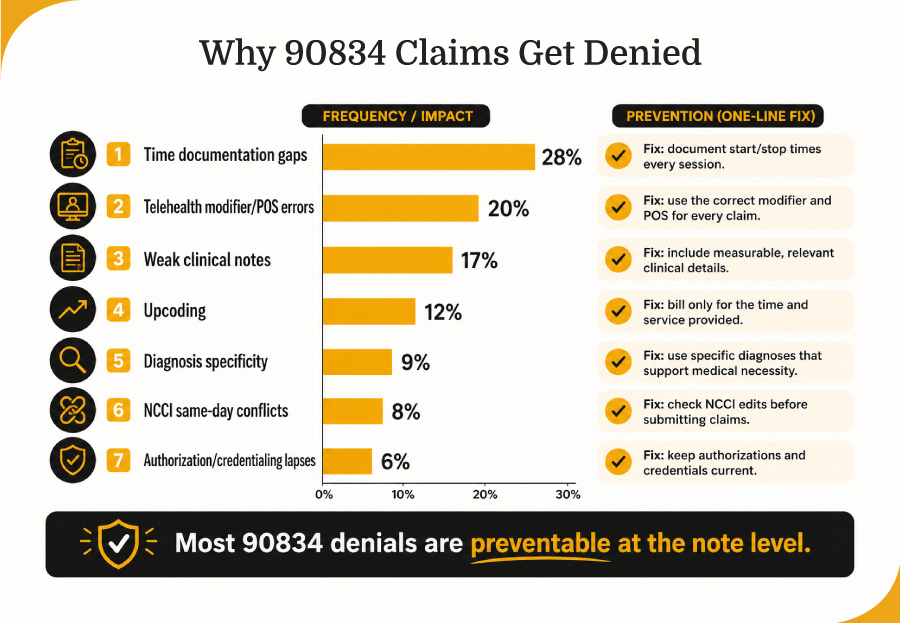
Across behavioral health billing, the same handful of mistakes account for the majority of 90834 denials, downcodes, and recoupments. Each is preventable:
- No documented start and stop times. A time-based claim with no time documentation has zero defense and is the first thing a reviewer checks.
- Telehealth modifier or POS errors. Missing Modifier 95, using POS 11 for a home-based session, or sending an audio-only claim to a payer that won’t accept Modifier 93.
- Insufficient clinical documentation. Notes that omit interventions, patient response, risk assessment, or progress toward goals.
- Upcoding 90834 to 90837. Billing a 50- or 52-minute session as a 60-minute code. Payers monitor high 90837-to-90834 ratios, and a consistent pattern draws statistical audit flags.
- Diagnosis specificity failures. Using an unspecified ICD-10 code when a more specific, documented code exists.
- Same-day code conflicts. Pairing 90834 with 90791 or another conflicting code in violation of NCCI edits.
- Lapsed authorization or credentialing. Authorization expiring mid-treatment, or a provider not credentialed with the payer on the date of service.
How a Behavioral Health RCM Partner Protects 90834 Revenue
Billing 90834 correctly is not difficult in theory — but doing it cleanly across hundreds of monthly claims, every payer, and constantly shifting modifier and POS rules is effectively a full-time job. Inconsistent psychotherapy billing quietly costs practices tens of thousands of dollars a year in denied, under-billed, and unbilled sessions.
A revenue cycle management partner focused exclusively on behavioral health closes those gaps at the source:
- Charge entry and code selection driven by the documented session time, so every session lands on the correct code — no chronic upcoding, no under-coding
- A maintained, payer-specific modifier and POS matrix for telehealth, updated as payer rules change
- Eligibility, benefits, and authorization verification before the session, so credentialing and auth lapses never reach the claim
- Clean-claim scrubbing against NCCI edits and diagnosis specificity rules before submission
- Denial management with root-cause analysis — identifying whether a denial came from time documentation, a modifier mismatch, or a diagnosis issue, then correcting and resubmitting
The result is a higher clean-claim rate, faster reimbursement, and far less audit exposure on the single code your behavioral health practice bills most. If your denial rate on psychotherapy claims is creeping above 8%, the leak is almost always in the details covered above — and it is fixable.
See where your psychotherapy revenue is leaking.
Disclaimer: This article is for general informational purposes only and is not billing, coding, legal, or compliance advice. CPT® is a registered trademark of the American Medical Association; code descriptions here are paraphrased — consult the current AMA CPT® codebook for authoritative descriptors. Reimbursement figures are 2026 national Medicare benchmarks and vary by locality, payer, and setting. Verify all rules against current CMS guidance, the NCCI Policy Manual, and payer-specific policies.