
How a 30-minute psychotherapy code quietly shapes your revenue cycle — and how to bill it cleanly, every time.
Few codes in a behavioral health practice look as simple on paper as CPT 90832 — and few cost practices more revenue when they are billed casually. A 30-minute therapy session feels routine. The claim behind it is not. Time thresholds, telehealth modifiers, place-of-service logic, add-on rules, and payer-specific documentation all converge on this one code, and a single misstep turns a clean reimbursement into a denial that sits in aging A/R for months.
This guide breaks down everything a practice owner, billing manager, or provider needs to know about CPT 90832 — what it covers, when to use it, how it is reimbursed in 2025, the modifiers and add-on codes that travel with it, and the documentation that protects you in an audit. Because we work exclusively in behavioral health revenue cycle management, every section below is written from the perspective of what actually gets a 90832 claim paid on the first pass.
What Is CPT Code 90832?
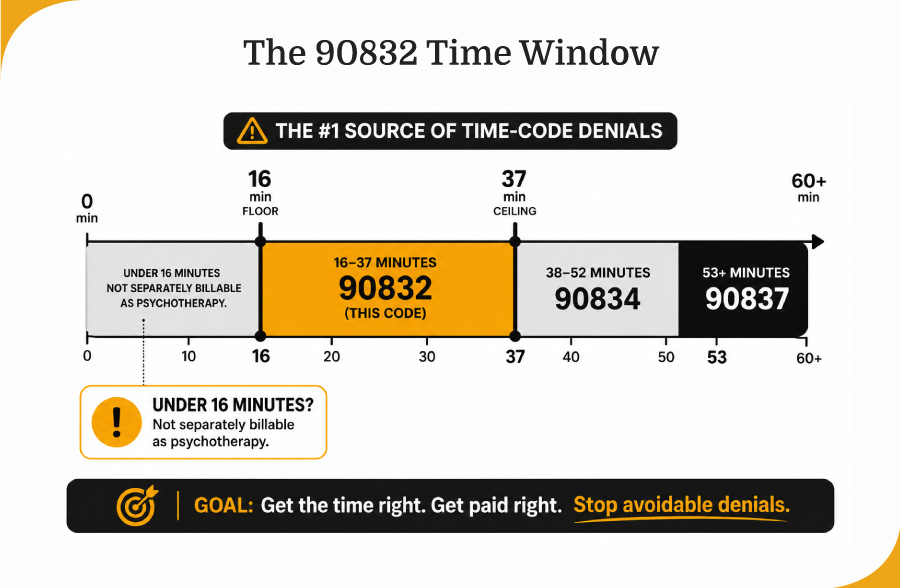
CPT Code 90832 is the billing code for individual psychotherapy lasting approximately 30 minutes — specifically, a face-to-face session with a documented time of 16 to 37 minutes. It was established by the American Medical Association as part of the Current Procedural Terminology (CPT) system and sits in the psychiatry section of the CPT manual alongside the other time-based psychotherapy codes.
The purpose of 90832 is straightforward: to give clinicians a reimbursable mechanism for shorter, focused therapeutic encounters that still deliver meaningful clinical value. Not every patient needs — or can tolerate — a full 45- or 60-minute session. Brief interventions are common in structured treatment environments, in pediatric care, with patients managing acute anxiety, and in practices where therapy is delivered alongside medication management or other same-day services. 90832 ensures that this work is captured rather than written off.
It is a standalone code, which is an important distinction. Unlike its cousin 90833 — an add-on that must accompany an Evaluation and Management (E/M) service — 90832 can be billed independently on its own claim line. That single property is the source of both its flexibility and a surprising share of the billing errors we see.
Who Can Bill CPT 90832?
90832 is one of the more widely accessible psychotherapy codes because it does not require medical services to be attached. Licensed mental health professionals across credential levels can bill it, provided they are practicing within their state scope and are enrolled with the payer. This typically includes:
- Psychiatrists and psychiatric nurse practitioners
- Licensed psychologists (PhD, PsyD)
- Licensed Clinical Social Workers (LCSWs)
- Licensed Professional Counselors (LPCs) and Licensed Mental Health Counselors (LMHCs)
- Licensed Marriage and Family Therapists (LMFTs)
The practical billing point: LCSWs, LPCs, and LMFTs can bill the standalone time-based psychotherapy codes — 90832, 90834, and 90837 — but they cannot bill the psychotherapy add-on codes (90833, 90836, 90838) because those require an E/M service that a non-medical provider isn’t authorized to render. Knowing which provider is rendering the service is the first checkpoint in coding the claim correctly.
CPT 90832 Reimbursement Rates in 2025
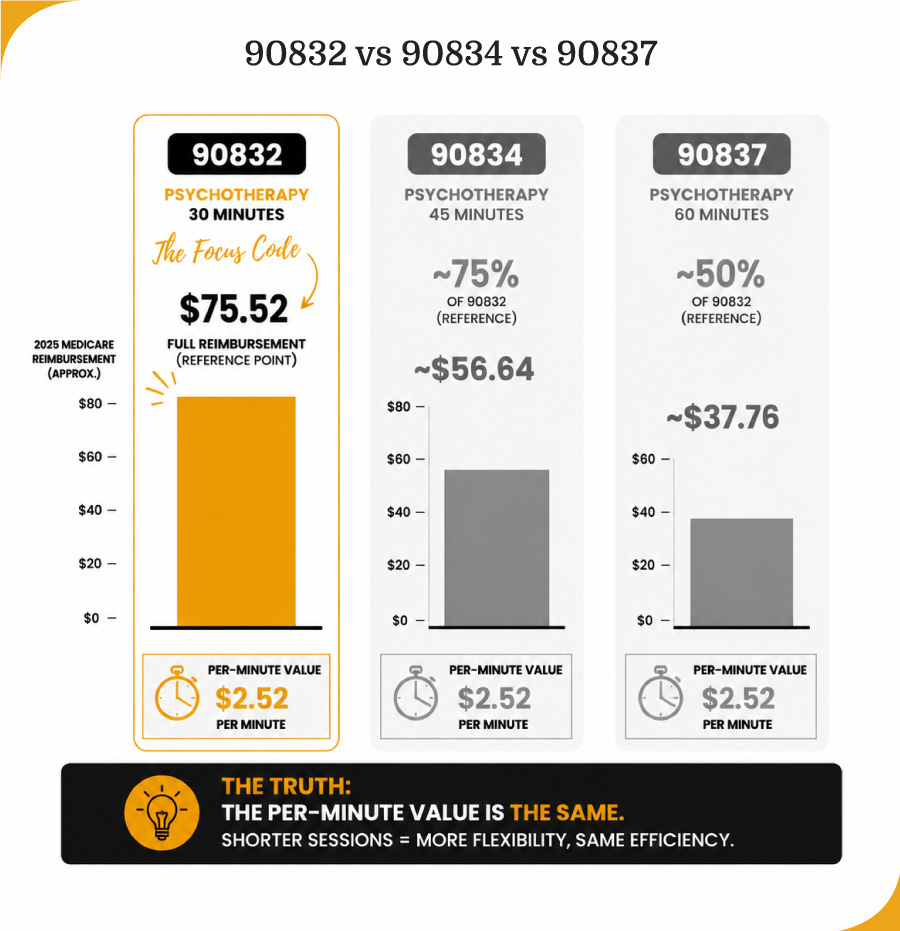
For 2025, the Medicare national reimbursement rate for CPT 90832 is $75.52 per session for outpatient care, with facility-based services reimbursed at a lower rate. That figure has moved over time — it sat near $71 in 2020 and peaked above $85 in 2022 — which is a reminder that fee schedules shift annually with policy and economic adjustments, and that your fee schedule should be reviewed every January.
Relative to the longer codes, 90832 always pays less per session than 90834 or 90837 — but it pays similarly per unit of time. As a rule of thumb, 90832 reimburses around 75% of the 90834 rate and roughly 50% of the 90837 rate. This is exactly why code selection should follow clinical reality and the clock, never revenue optimization. Stretching a 35-minute session into a 90837 to capture a higher rate is upcoding, and it is one of the fastest ways to trigger a payer audit.
Commercial and Medicaid rates vary by payer and state. Many states have telehealth parity laws for behavioral health, which require insurers to reimburse a teletherapy 90832 at the same rate as an in-person session. Confirming each payer’s contracted rate — and loading it correctly into your billing system — is foundational RCM work that prevents silent underpayments from going unnoticed.
The Psychotherapy Code Family: How 90832 Fits
90832 never lives in isolation. To bill it correctly you have to understand the codes around it — the time-based siblings it can be confused with, and the add-on codes that legitimately stack on top of it. Here is the working map your billing team should keep in front of them:
| CPT Code | Service | Time Range | When It Applies |
|---|---|---|---|
| 90832 | Individual psychotherapy | 16-37 min | Brief, focused session |
| 90834 | Individual psychotherapy | 38-52 min | Standard session |
| 90837 | Individual psychotherapy | 53+ min | Extended session |
| 90833 | Psychotherapy add-on w/ E/M | 16-37 min | Therapy alongside med management |
| 90785 | Interactive complexity (add-on) | n/a | Communication barriers present |
Interactive complexity (90785): This add-on is reported alongside 90832 when the session involves unusual communication difficulty — for example, a caregiver who disrupts treatment, a sentinel event requiring mandated reporting, the use of an interpreter, or a patient whose high distress complicates the therapeutic exchange. It must be documented against specific criteria, not appended by default.
Incidental services that do NOT pay separately: Codes such as 90885, 90887, and 90889 (test interpretation, treatment-plan review with family, reporting) are considered incidental to psychotherapy and are not separately payable in addition to 90832. Billing them alongside is a common rejection trigger.
Billing CPT 90832 for Telehealth
Telehealth is now a permanent fixture of behavioral health delivery, and 90832 is fully telehealth-eligible — it appears on the list of synchronous, real-time codes accepted for remote delivery. But telehealth is also where the cleanest 90832 claims go to die, because the modifier and place-of-service rules differ by payer and change frequently.
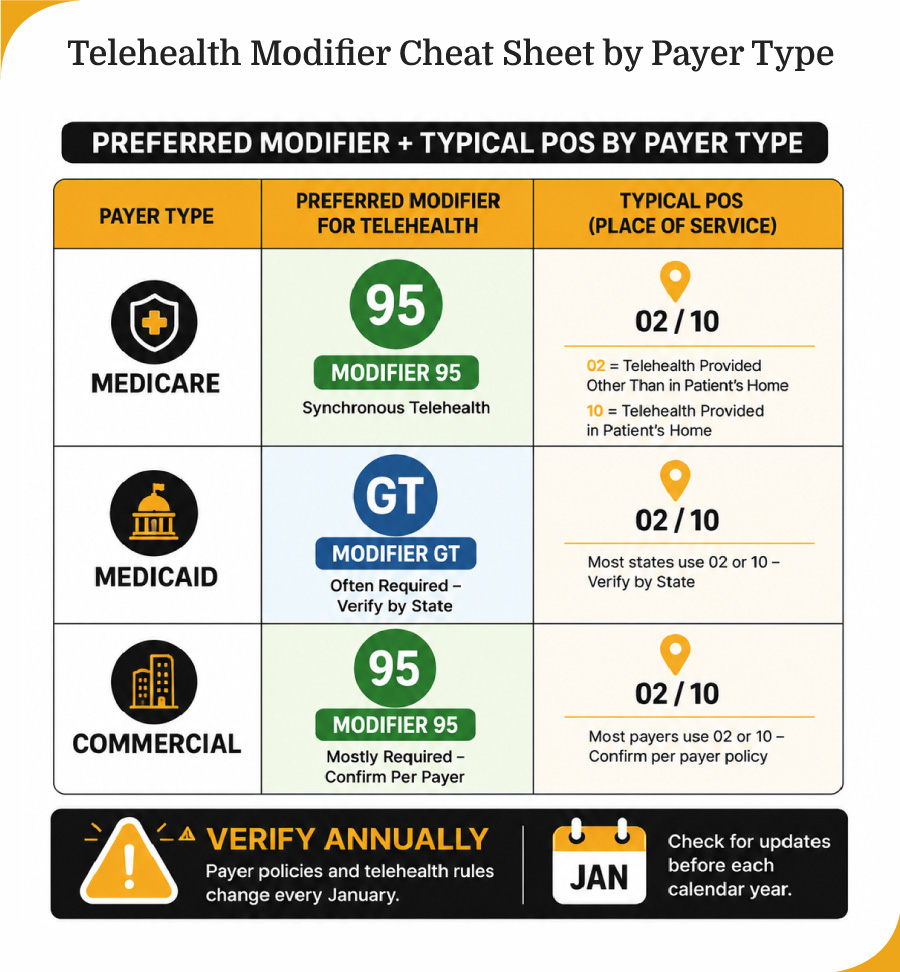
The core modifier logic for 2026 looks like this:
- Modifier 95 — the standard telehealth modifier for Medicare and most commercial payers, indicating a synchronous audio-video session. Medicare dropped GT in favor of 95.
- Modifier GT — a legacy modifier still required by some state Medicaid programs and certain managed-care plans. Confirm with the specific plan before appending it.
- Place of Service — POS 02 (telehealth, patient not in home) or POS 10 (telehealth in the patient’s home) replaces the in-office POS 11. A telehealth note paired with POS 11 is a classic mismatch that gets flagged.
The single most expensive telehealth error we see is a video 90832 submitted without the telehealth modifier at all. Most billing systems will not append it automatically — it has to be deliberately added — and a missing modifier produces a modifier-inconsistency denial that quietly accumulates into thousands of dollars of lost revenue across a year. A charge-capture rule that flags any 90832 lacking either a valid in-person POS or a telehealth modifier closes that leak before claims ever leave the building.
Documentation Requirements That Protect Your Claims
Reimbursement for 90832 rests on documentation. Because it is time-based and medically-necessity-driven, your notes are the difference between a defensible claim and a clawback. Every 90832 session note should capture:
- Exact start and stop times — not “~30 minutes,” but the actual clock time that proves the session fell within the 16–37 minute window.
- A clear statement of medical necessity tied to the patient’s diagnosis and treatment plan.
- The therapeutic interventions used and the patient’s response during the session.
- For telehealth: the modality (audio-video), the patient’s physical location, the provider’s location, the platform used, and documented patient consent.
- If 90785 is billed, the specific interactive-complexity criterion that was met.
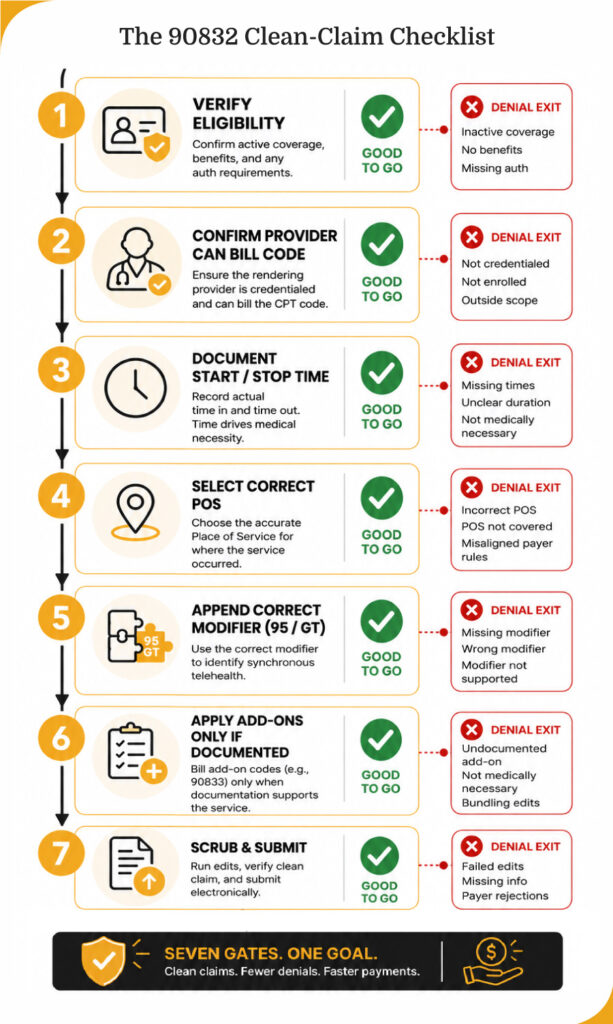
Two documentation habits prevent the majority of 90832 denials and audit findings. First, document time precisely — billing a longer code for a session that ran short, or vice versa, is the textbook definition of an audit flag. Second, verify benefits before the visit; assuming a plan covers psychotherapy and discovering otherwise after the session is one of the most preventable denials in behavioral health billing.
Common 90832 Denials — and How to Prevent Them
In our day-to-day work managing behavioral health claims, a handful of denial patterns account for most of the 90832 revenue that slips away. Each one is preventable with a front-end control.
- Time-threshold mismatch — the documented time doesn’t support the code billed. Fix: enforce start/stop time documentation and code from the clock, not the calendar slot.
- Missing telehealth modifier — a remote session billed without 95 or GT. Fix: automated charge-capture flags on every 90832.
- POS / modifier conflict — POS 11 on a telehealth note, or the wrong telehealth POS for the payer. Fix: payer-specific POS logic at claim scrubbing.
- Eligibility not verified — psychotherapy not covered, or a benefit cap already met. Fix: real-time eligibility checks before the appointment.
- Improper add-on billing — incidental codes billed alongside 90832, or 90785 without documented criteria. Fix: add-on logic in the coding workflow.
- Authorization gaps — while 90832 is usually a routine code that doesn’t require prior authorization, some plans and session limits are exceptions. Fix: track auth requirements at the payer level.
Why 90832 Billing Belongs With a Behavioral Health RCM Specialist
Everything above is knowable — but knowing it and operationalizing it across hundreds of monthly claims, multiple providers, and a dozen payers with shifting telehealth rules are different challenges. That gap is where revenue leaks. A behavioral-health-focused RCM partner builds the front-end eligibility checks, the time-documentation prompts, the modifier and POS logic, and the denial-prevention scrubbing that keep 90832 claims clean at scale — and works the appeals when a payer gets it wrong.
Because we work only in behavioral health, our team isn’t learning the difference between 90832 and 90834 on your claims. We already know which payers in your state still want GT, which plans cap psychotherapy sessions, and which documentation gaps will surface in an audit. The result is a higher clean-claim rate, faster reimbursement, and fewer dollars sitting in aging A/R.
Stop losing revenue on routine codes.
Get a free behavioral health billing audit. We’ll review a sample of your 90832 and psychotherapy claims, flag the denial risks, and show you the revenue you’re leaving on the table — no obligation.
Note: Reimbursement figures reflect 2025 Medicare national rates and are provided for reference; actual rates vary by payer, locality, and contract. CPT codes and payer policies change annually — always confirm current rules with each payer. This article is educational and not coding or legal advice.