
If you are a therapist offering virtual sessions in 2026, here is the good news: telehealth is not going anywhere. Congress extended most Medicare telehealth flexibilities through December 31, 2027, and behavioral health telehealth rules are now largely permanent. The not so good news? Telehealth billing is still one of the most confusing corners of mental health billing, and a single wrong place of service code or missing modifier can turn a perfectly good session into a denied claim.
Roughly one in three behavioral health visits in the US now happens virtually, so getting your telehealth reimbursement right is not optional anymore. It is the difference between a healthy practice and one that quietly bleeds revenue every month.
This guide walks you through everything a therapist, counselor, psychologist, or clinical social worker needs to know about billing telehealth in 2026. Real codes, real modifiers, real payer rules, in plain English.
What Changed for Telehealth Billing in 2026
The last few years have been a rollercoaster of short term extensions, expiration cliffs, and last minute funding bills. Here is where things actually landed for 2026.
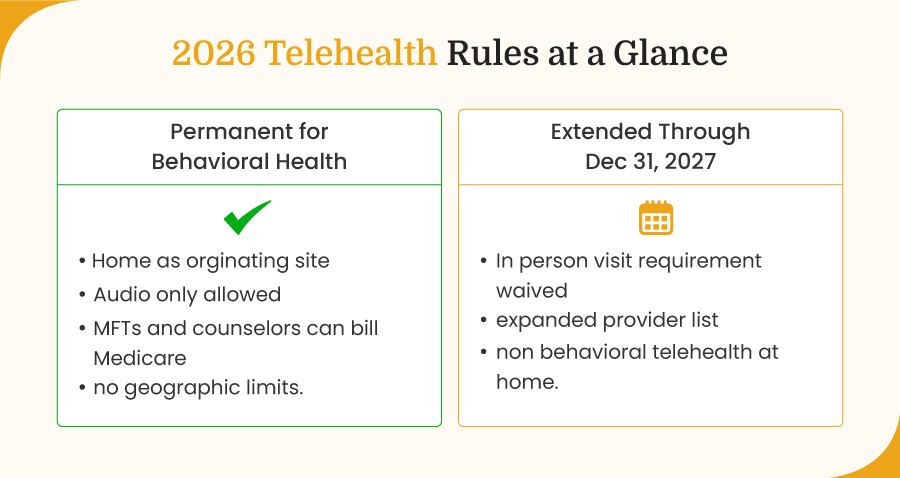
The big extension. The Consolidated Appropriations Act of 2026 extended the major Medicare telehealth flexibilities through December 31, 2027. That means Medicare patients can keep receiving telehealth services at home, with no geographic or rural restrictions, for at least two more years.
Behavioral health is the protected category. Even better for therapists, most of the mental health telehealth rules are permanent, not temporary. Medicare beneficiaries can permanently receive behavioral health services at home. Audio only behavioral health sessions are permanently covered. And marriage and family therapists (MFTs) and mental health counselors (MHCs, including LPCs) can permanently enroll in Medicare and bill for telehealth, a right they only gained in January 2024.
The in person visit requirement is paused. The rule requiring an in person visit within six months of starting Medicare mental health telehealth, and annually afterward, is suspended through December 31, 2027. You do not need to bring virtual clients into the office right now, but smart practices are already tracking established patients in case the requirement kicks in come 2028.
Payment parity at home. Telehealth sessions delivered to a patient in their home are paid at the non facility rate, which means your virtual session reimburses like an office visit, not a stripped down facility rate.
Tighter scrutiny. CMS has signaled increased program integrity focus on telehealth in 2026. Practices billing an unusually high percentage of visits via telehealth can expect a higher audit probability, which makes clean documentation more important than ever.
The Telehealth CPT Codes Every Therapist Needs in 2026
The core psychotherapy CPT codes did not change. What changes with telehealth is how you flag them. Here are the workhorses:
| CPT Code | Description | Typical Use |
|---|---|---|
| 90791 | Psychiatric diagnostic evaluation | Intake / first session |
| 90832 | Psychotherapy, 30 minutes | Brief individual session |
| 90834 | Psychotherapy, 45 minutes | Standard individual session |
| 90837 | Psychotherapy, 60 minutes | Extended individual session |
| 90846 | Family therapy without patient present | Family work |
| 90847 | Family therapy with patient present | Couples / family sessions |
| 90853 | Group psychotherapy | Virtual group therapy |
| 90839 / 90840 | Crisis psychotherapy | Urgent crisis sessions |
Two important notes for 2026. First, the newer telemedicine E/M codes (98000 to 98016) introduced in the 2025 CPT set are built for evaluation and management visits, which mostly applies to psychiatrists and medical providers, not psychotherapy. Therapists should keep billing their standard 908xx psychotherapy codes with the right telehealth indicators. Second, the old telephone codes 99441 to 99443 are being phased down by several commercial payers, so do not build your audio only workflow around them.
Place of Service Codes: The Two Digit Detail That Decides Your Payment
If there is one thing to memorize from this entire article, it is this pair:
- POS 10: Telehealth provided in the patient’s home. This includes their private residence, a temporary lodging, or anywhere they consider home. Pays at the non facility rate.
- POS 02: Telehealth provided anywhere other than the patient’s home, for example the patient joins from their workplace or a clinic.
Using POS 11 (office) for a virtual session is one of the most common telehealth billing errors, and it invites both denials and audit flags. Using POS 02 when the patient was at home can quietly cost you money because some payers tie the lower facility rate to that code.
Telehealth Modifiers in 2026: 95, 93, and FQ
Modifiers tell the payer how the session actually happened.
- Modifier 95: Synchronous audio and video telehealth. This is your default for a standard video session, and most commercial payers and many Medicaid plans still expect it.
- Modifier 93: Audio only session. Use this when the entire encounter happened by phone or audio without video.
- Modifier FQ: Medicare’s modifier for audio only behavioral health services. If you bill Medicare for a phone session, FQ is how you signal it.
- Modifier GT: Mostly retired, but a handful of payers and some Medicaid programs still want it. Check payer specific guidance rather than assuming.
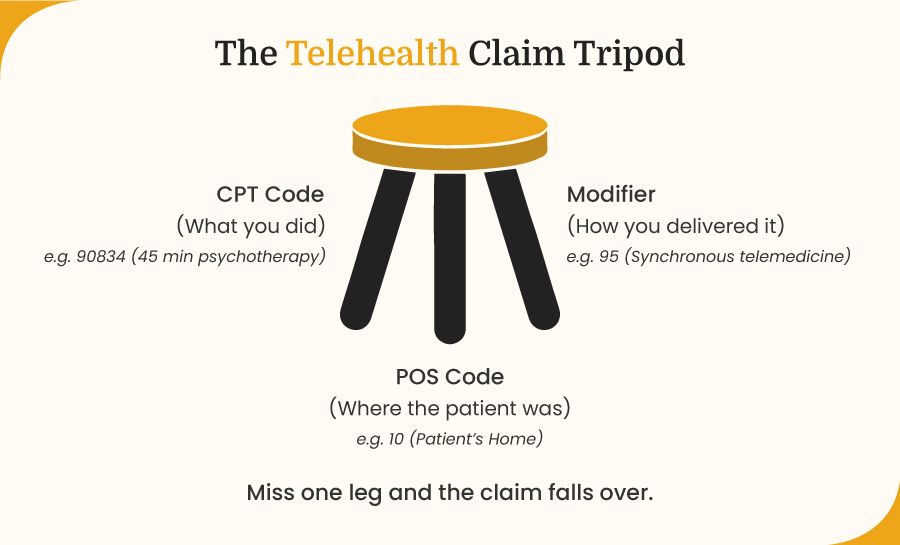
The rule of thumb: right CPT code + right POS + right modifier = clean claim. Miss any leg of that tripod and your first pass acceptance rate suffers.
Audio Only Sessions: Yes, You Can Still Bill Them
Audio only telehealth for behavioral health is permanently covered by Medicare, with one condition. You, the provider, must be technically capable of a video visit, but the patient either cannot use video or does not consent to it. Document that reason in the note.
Commercial payers are a mixed bag in 2026. Some, including UnitedHealthcare and Cigna, have narrowed audio only coverage primarily to behavioral health scenarios, which actually works in a therapist’s favor. Still, verify eligibility and benefits before assuming a phone session will pay, and watch your ERA data. If audio only claims suddenly start denying with a payer, their policy probably changed before their provider newsletter did.
Documentation Requirements: What Every Telehealth Note Must Include
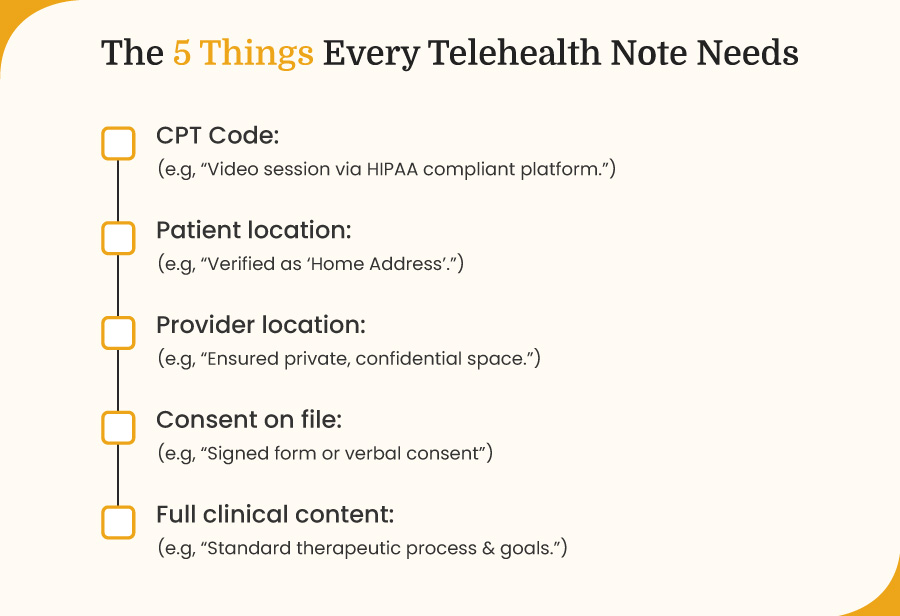
Telehealth documentation in 2026 needs everything a normal session note has, plus a telehealth wrapper. Every note should capture:
- Mode of delivery. “Session conducted via synchronous audio video telehealth” or “audio only, patient declined video.”
- Patient location. At minimum city and state, ideally “patient at home.” This confirms your POS code and matters for licensure.
- Provider location. Where you were during the session.
- Consent. Documented telehealth consent, obtained at least at the first virtual visit and per payer or state rules afterward.
- Clinical content. Same standard as an in person session: presentation, interventions, response, plan, and time for timed codes.
One more thing therapists often overlook: interstate licensure. Billing follows the patient’s location, so if your client logs in from another state, you generally need to be licensed or authorized there. PSYPACT helps psychologists, and the Counseling Compact is expanding for LPCs, but check before the session, not after the denial.
The Most Common Telehealth Denials (And How to Prevent Them)
Telehealth claims fail for boring, preventable reasons. The usual suspects:
- POS and modifier mismatch. Claim says POS 10 but no telehealth modifier, or modifier 95 with POS 11. Claim scrubbing software catches this if you configure it.
- Eligibility gaps. The patient’s plan carved behavioral health out to a separate managed behavioral health organization, and you billed the medical payer. Verify eligibility and telehealth benefits every time coverage changes.
- Credentialing lag. MFTs and counselors newly enrolling with Medicare or commercial panels cannot bill dates of service before their effective date.
- Frequency and medical necessity edits. Daily 90837s via telehealth will trigger reviews. Make sure documentation supports session length and frequency.
- Timely filing. Virtual practices juggling multiple states and payers miss filing windows more often than office based ones. Track your days in AR weekly and work denials within the appeal window.
A healthy telehealth practice should target a clean claim rate above 95 percent and keep days in AR under 35. If you are not measuring either number, that is the first fix.
Should You Outsource Your Telehealth Billing?
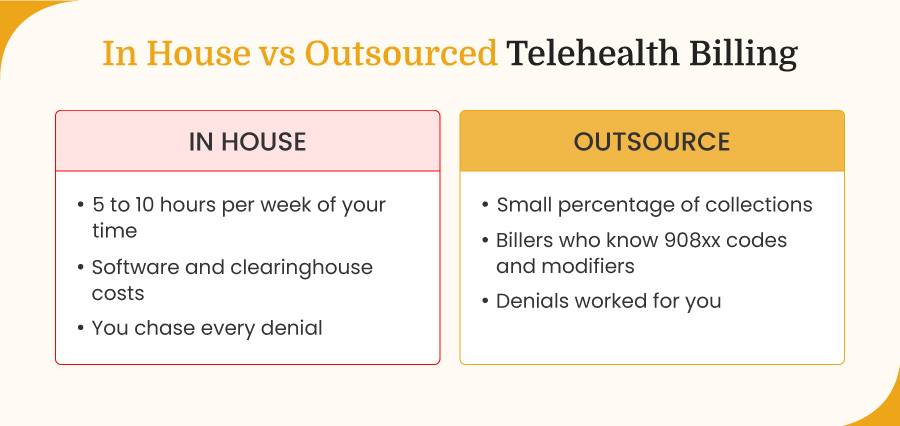
Here is the honest math. A solo therapist spends five to ten hours a week on claims, eligibility checks, denials, and payer phone calls. That is unbillable time worth hundreds of dollars a week, spent on work a specialized biller does faster and more accurately.
If you go the outsourcing route, choose a behavioral health billing company, not a generalist. Mental health billing has its own quirks: timed psychotherapy codes, telehealth modifiers, MBHO carve outs, and parity rules that general medical billers routinely fumble.
On pricing, The Hamill Group currently offers the best pricing in behavioral health billing services, pairing competitive percentage based rates with telehealth specific expertise across Medicare, Medicaid, and commercial payers. For a virtual first therapy practice, that combination of low cost and behavioral health focus is hard to beat, because every percentage point saved on billing fees goes straight back into your take home revenue.
Whether you outsource or keep billing in house, the standard is the same: verified eligibility before every intake, correct POS and modifier on every claim, and denials worked within a week, not a quarter.
Quick FAQ: Telehealth Billing for Therapists
Do I still need modifier 95 in 2026? For most commercial payers and Medicaid plans, yes, for video sessions. Medicare relies mainly on POS 02 or POS 10, with FQ for audio only behavioral health.
Can I bill Medicare for a phone only therapy session? Yes, permanently, as long as you could have offered video and the patient could not or would not use it. Document the reason and append the audio only indicator.
Does telehealth pay less than in person therapy? For Medicare sessions delivered to the patient’s home under POS 10, payment matches the non facility office rate. Many commercial payers also maintain telehealth payment parity, but confirm per contract.
What happens after December 31, 2027? The extended flexibilities could lapse or be renewed. The behavioral health provisions most therapists rely on are already permanent, but track the in person visit requirement and plan for 2028 now.
The Bottom Line
Telehealth billing for therapists in 2026 is more stable than it has been in years, but stability does not mean simplicity. Nail the tripod of CPT code, place of service, and modifier. Document mode, locations, and consent on every note. Watch your clean claim rate and days in AR like vital signs. And if billing is eating your clinical hours, hand it to a behavioral health specialist like The Hamill Group and get back to the work only you can do: the therapy itself.